Wesley-Barrell is delighted to announce the launch of the third Wesley-Barrell Craft Awards. The Wesley-Barrell Craft Awards 2011 are designed to put British craftsmanship in the spotlight and recognise the wealth of talented makers that work in Britain today.
Who should Enter
Aimed at established makers who work professionally in Britain.
Categories
• Furniture
• Vessels for Interiors
Why Enter
• Shortlisted pieces will be showcased in a touring exhibition including Art in Action at Waterperry Gardens, Oxfordshire and Wesley-Barrell’s flagship showroom in Wigmore Street during London Design Festival.
• A cash prize of £2,500 will be awarded to a winner from both categories.
• Each winner will also benefit from a business mentoring scheme with Wesley-Barrell
Judging criteria
The eminent panel of judges includes Jon Snow – Newscaster, Channel 4 News, Katrina Burroughs – Columnist for the Sunday Times, Peter Ting – Ceramicist, Alastair Graham – Furniture consultant, Helen Chislett – Journalist and Juliette Barrell – from Wesley-Barrell.
The judging panel will be particularly focused on the use of traditional craft skills utilised in an innovative and contemporary way to create beautiful and handcrafted one-off pieces.
How to enter
Entries must be submitted by Sunday 13th February 2011 . To enter makers should complete an entry form by clicking onto this link Application 2011 by requesting a hard copy from Ali Griffiths at Wesley-Barrell, Ducklington Mill, Standlake Road, Ducklington, Oxon, OX29 7YR. Tel. 01993 893108 or email alison.griffiths@wesley-barrell.co.uk.
Winners of each category will be announced at Art in Action 21-24 July 2011.
In 1901 there were 6800 saddlers working in Walsall. Little wonder then that the train station is in the saddler centre and the football team are nicknamed the saddlers but how much of the craft is alive today?
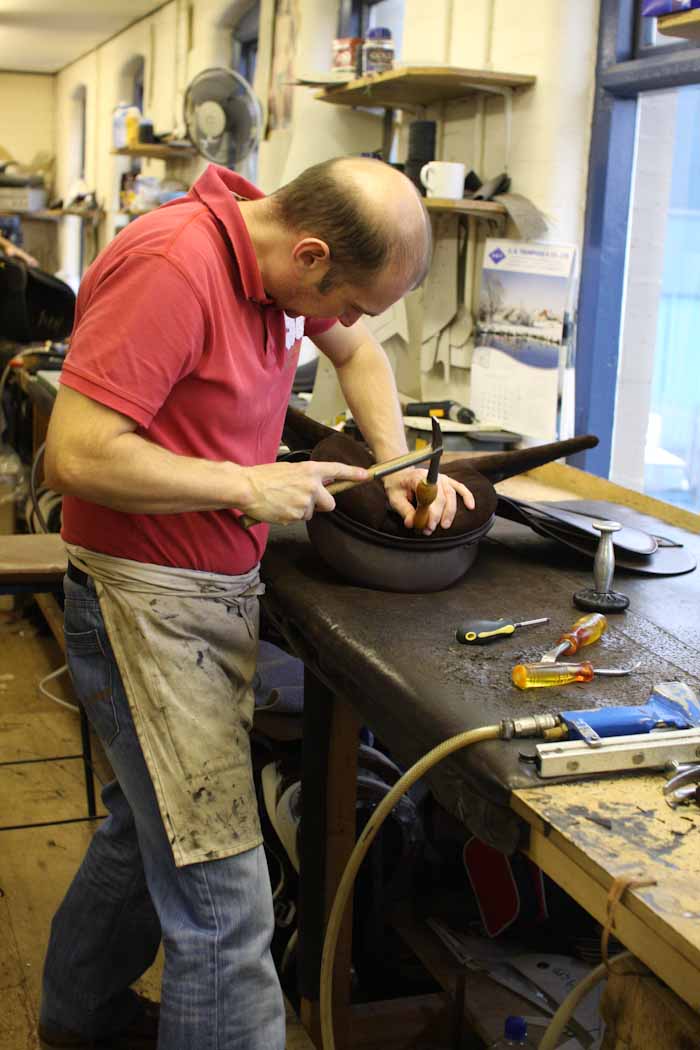
This is the workshop of Frank Baines one of the twenty or so saddlers listed in Walsall yellow pages.
This is Frank in the saddle tree room with Carol Robinson a distant relative and trustee of the Heritage Crafts Association.
The saddle tree is like the skeleton of the saddle, most are made of laminated plywood with spring steel but saddlers are always innovating and experimenting with new materials such as carbon fibre.
There are 5 or 6 tree makers left in Walsall but saddlers need to keep a good stock across a wide range of sizes. Where cheap saddles are off the peg like suits Frank Baines offers the equivalent of a Saville Row bespoke suit. The saddle has to fit horse and rider and spread the weight effectively and comfortably, every one is made to measure.
Before we move on from trees I must share this one. This is an old Swedish tree, all wooden, at least 100 years old and it uses a sliding tapered dovetail joint, something I have only seen in Eastern Europe.
Next thing is the pattern, worked up by Frank from measurements carefully taken from horse and rider.
The whole workshop smells gloriously of quality leather, each saddle uses many different types in different parts.
These are the cutting tools honed to a good edge on a leather strop.
Rolls of softer leather I can still smell it just seeing the pictures.
Cutting out.
Then follows an awful lot of hand stitching. Each saddler has a workbench and works on a single saddle through all the stages. Frank has his bench alongside and spends more time at the bench than in the office.
It is clearly hard work on the forearms as everyone had muscles like Popeye.
This mushroom like tool was used to beat the saddle to help pull stitches really tight.
Like this.
Now I don't know anything about saddles but last night when I told a horse loving friend where I had been she was very envious, Frank Baines is clearly the Rolls Royce of dressage saddles.
I took a couple of short video clips showing work in progress.
and a view around the workshop.
It was a joy to see Frank and his team at work, the commitment to quality and tradition whilst still being open to change and improvement. This is their website.
Guest bloger Nigel Townshend with some background to Edwardian Farm.
Throughout the whole series of Edwardian Farm you get a real sense of a world changing, this was the time when globalisation was emerging and UK cottage industries were struggling to compete with factory produced goods. In Episode five of Edwardian Farm , we were given an insight into the cottage industry of lace making.
Lace making, as we know it today, has been around since the 16th Century and is thought to originate in Venice. Lace was soon being made across Europe, including England. For some reason, and I would be really interested to know why, Devon became associated with quality lace making, in fact half of all inhabitants of East Devon were lace makers. One place in particular that become synonymous with lace making was the town of Honiton, which became world famous for its lace, renowned for its beauty, delicacy and intricacy.
I’ve always thought of lace as being incredibly intricate and beautiful, but I had never considered just how much time and work goes into producing it, so I was amazed to learn that to produce just a one inch square piece of lace, it takes between 9 -10 hours! It was therefore not surprising to learn that lace was considered the jewellery of its day. Lace making was a real cottage industry and every girl in Honiton would be taught lace making, in fact in Devon, lace making was taught as part of the school curriculum up until 1960.
Lace was often made in groups with women sometimes specialising in one aspect of a design e.g. producing flowers, butterflies, etc. the more experienced ladies of the group would then collect and assemble the pieces. There is a wealth of information on the website of the Lace Guild of Great Britain http://www.laceguild.demon.co.uk
This video produced by The Lace Guild of Great Britain illustrates the basics of bobbin lacemaking and needle lacemaking:
In Croatia lacemaking is recognised as part of the country's intangible heritage the list of things the government are doing to preserve and promote lacemaking at the end of this short film is impressive.
In contrast to the delicate lace, the other main focus of the program was on mining.
Morwhellam Quay, which is where Edwardian Farm is filmed, is now a heritage centre but in the 19 century it was the busiest inland port in Britain, where ships of up to 300 tonnes would visit to pick up copper which had been extracted from the George & Charlotte copper mine. Archaeologist and HCA Patron, Alex Langlands headed down the mine as he and fellow archaeologist Peter Ginn looked at one of the ways farmers tried to supplement their income.
By Edwardian times, rising costs of running the George and Charlotte mine, meant it could no longer compete with cheap foreign copper imports and the mine was abandoned .However, there was still some money to be made be scavenging the spoil heaps. This scavenging for copper, which involved breaking up rocks and looking for the copper ore within them, was known by the rather wonderful term, ‘fossicking’. The income from this was limited and many Devon farmers would also head across the river to Cornwall to the tin mines, Which is what Alex and Peter did.
However, before they could head down the tin mines of Cornwall, Peter Ginn visited blacksmith Simon Summers to collect a pick axe, which needed repairing and hardening so it could be used for working with stone.
The process of hardening and tempering steel is straightforward but crucial. First Simon heated the tip of the pick till it was very hot – the metal was a cherry red in colour - he then cooled the very tip of the pick, leaving around two inches of steel still glowing red. thios makes the steel tip very hard but brittle (hardening) Simon then watched the colours change in the metal, as the heat flowed back towards the tip. As the steel warms it changes colour and each temperature/colour relates to a specific harness so it is getting gradually softer but tougher (tempering). Simon explained that this process allowed blacksmiths to temper steel at different strengths for different jobs for stone the blacksmith will look for a yellow/straw colour before quickly quenching the steel to stop any further softening.
For more info on blacksmithing including courses etc contact BABA
Working in the mine was a tiring, difficult and dangerous job. While the invention of a drill, that worked by compressed air supplied by a steam engine, speeded up the process (what could be drilled in an hour by hand, could now be done by machine in a minute) the job became more dangerous, due to the amount of dust that was created; this was particularly problematic when drilling through quartz and is why the drill was known as the widow maker.
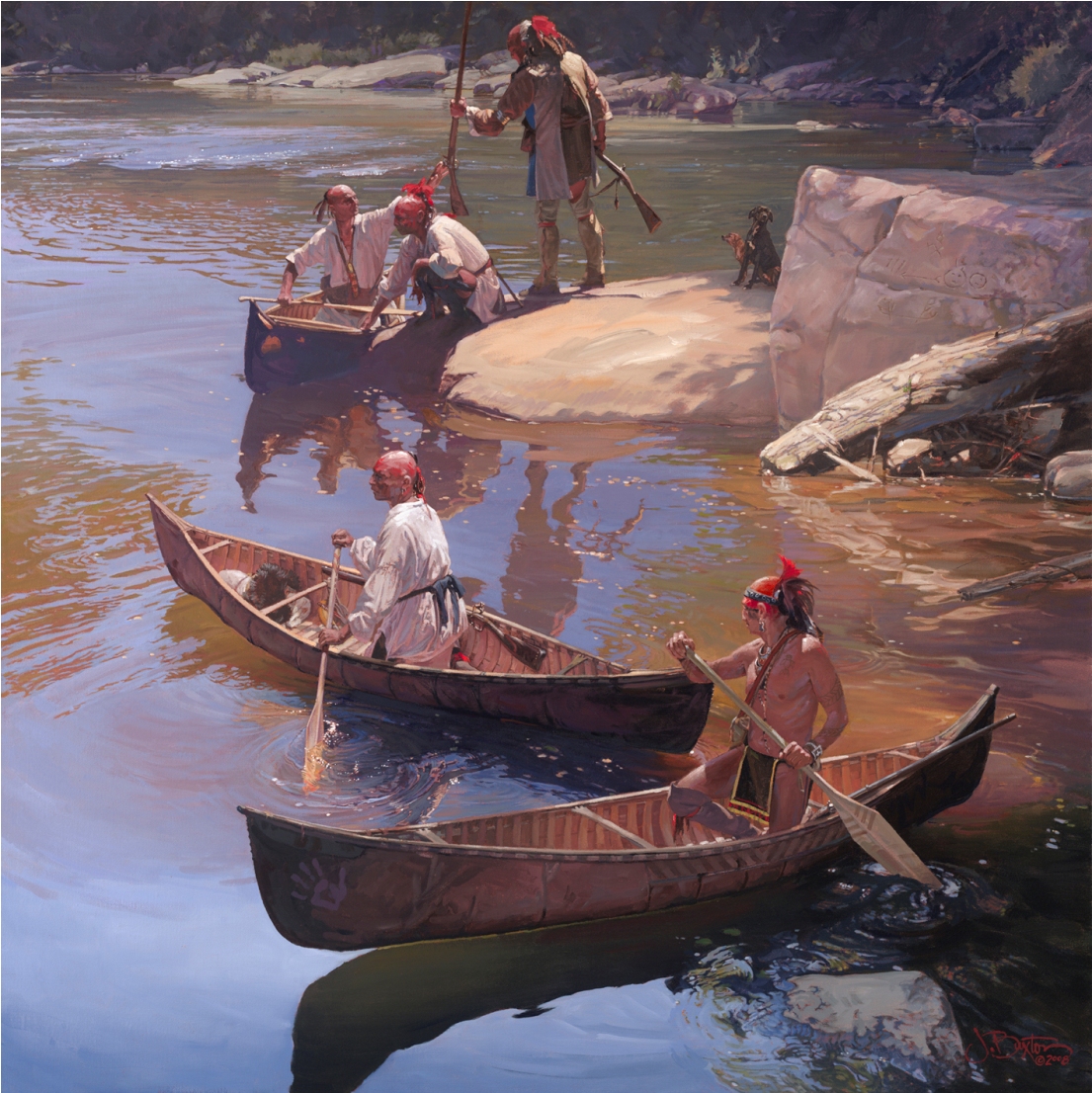
National Maritime Museum Cornwall and one of the oldest, and most influential families, in Cornwall are working together to conserve possibly the oldest Birch Bark Canoe in existence.
Estimated to be over 250 years old, the canoe has been discovered on the Enys Estate near Penryn, housed in one of the Enys family’s barns.
Laid to rest for a number of years, the canoe saw daylight for the first time in decades today when it was moved from its shed to its new temporary resting place at National Maritime Museum Cornwall. The Museum’s boat restoration and curatorial team lifted and transported this rare find to the Maritime Museum in Falmouth where she will be conserved, preserved and put on display to the public before being repatriated to Canada.
Andy Wyke, Boat Collections Manager says: “Moving the canoe is the beginning of a whole new journey back to Canada for this incredible find. For over 200 years, the canoe has belonged to the Enys family having been brought to Cornwall by Lt John Enys after his time fighting in the American War of Independence in 1776.
Lt Enys sailed from Falmouth in a Packet Ship to join his regiment in Canada to relieve the city of Quebec which was under siege from the Americans. He fought many military campaigns and toured the area for his personal interest – discovering this canoe along the way. It’s incredible to think its legacy has been resting in a barn in Cornwall all this time.”
Wendy Fowler, a descendent of the Enys family, whose records date back to the 13th century, called the Maritime Museum to request they look at the canoe lying in the Estate’s barn. She says: “The Estate is very special to us and holds many secrets but I believe this is the most interesting to date. The Maritime Museum are brilliantly ensuring and repatriating another element of our great family history and I’m most grateful that my great, great, great, great, great Uncle’s travels have led to such a major chapter of boating history being discovered in Cornwall.”
Captain George Hogg, Archivist and Trustee of the National Maritime Museum Cornwall, says: “When we received the call from the Enys family to identify their ‘canoe in a shed’ we had no idea of the importance of the find. We knew we had something special, but having worked with the British Museum on the artefacts and the Canadian Canoe Museum in Peterborough, Ontario, we now believe that this is one of the world’s oldest Birch Bark Canoes. This is a unique survival from the 18th century.”
Prior to her arrival at the Museum, the canoe was digitally recorded by the curatorial team and during the canoe’s time at the Museum, teams will be researching her history, conserving the remaining wood and preserving what’s left as well as preparing her for the trip back home and representing what she might have looked like over 250 years ago.
After September, the Native American canoe will be repatriated to Canada where the Canadian Canoe Museum will extend further research to see where the boat may have been built and by which tribe. Curators from the Canadian Museum are especially excited to receive this rare and unique part of their history as rarely do they have ‘live’ historic canoes of this far reaching history to help them reveal their own past.
The Birch Bark Canoe is planned to go on display, with supporting artefacts, in the Main Hall of National Maritime Museum Cornwall from late January to September 2011.
My favourite craft film ever is of 67 year old Cesar Newashish building a birch bark canoe, 57 minutes of pure woodworking bliss, simple tools and knowledge of materials to create something of great beauty and utility. view it free online here http://www.nfb.ca/film/Cesars_Bark_Canoe/
A 7th generation Onggi pottery operated by the Kim family and lead by Kim Il-Maan, a Korean National Cultural Treasure, filmed by Adam Field who was apprenticed there for most of 2008
This is the first stage, though if you were watching closely you will have seen this in the background of the previous film.
Glazing big pots, hard physical work but they are very efficient.
The kiln
These films were uploaded to youtube by Adam Field, this is him making a pot start to finish timelapse, a fun film. I really appreciate him putting this material in the public domain. I also really like his pots.
It has been a pleasure to watch Edwardian Farm. HCA Patron Alex Langlands has been trying out more crafts this time joining Nigel Legge lobsterpot maker, artist, fisherman. He seemed like a lovely bloke with a fine accent. He also seems to have a perfect lifestyle with a mix of making lobster pots, painting and taking holiday makers on boat trips. Next time I am down that way I shall definitely look him up. Alex said "Nigel was a top chap - really understated his skills - a great painter too. It was one of those magical days spent down there in Cornwall."
The pots worked too.
I was envious of Peter Gynn too visiting the wonderful J &FJ Baker oak bark Tannery. Here is owner Andrew Parr the tannery has been in the family since 1864 and is one of the last tanneries in the UK still using oak bark, I loved the water powered bark grinder. My friend Owen Jones the swill basket maker who was featured in Victorian farm supplies them with some of their oak bark.
It was a very photogenic place, first the hide was soaked in lime, then the hair scraped away. Then it was immersed in vats with oak bark for a year.
Finally it was oiled, dried and finished with dubin.
Whilst I am posting I'll include a couple of links from episode 2 which I missed at the time. Peter went to St Fagans in Cardiff to meet a cooper. Shame they didn't know about Alistair Simms the last master cooper of Wadworth's at Devises.
I was pleased to see Alex with his Sussex Trug, it seemed appropriate since he has light Sussex chickens and trugs were mass produced and sold around the country.
The fencing on the right is also a Sussex specialty but one which has only recently traveled further afield as horsey folk can afford to have the heavy sweet chestnut rails transported. It still looks better than the tanalised softwood fence on the left though. I find it interesting that fencing is seemingly invisible to people. Few folk would notice this modern fence and I wonder if the production company decided to let it go whilst going to great lengths elsewhere to keep as much as possible true to the Edwardian time frame.
This is Englands last working slate mine at Honister, a real good news story. The notes below are taken from their website.
In 1986, after three centuries of near continuous slate mining at Honister, the mine closed down after a protracted period of decline. With it, it seemed, went the last vestiges of traditional extraction and finishing techniques, as well as more than twenty local jobs. For the next ten years, any attempts to revive the industry were vexed by legal and financial issues and there was a real danger that the mine would fall into irreversible decay.
However, in 1996, its fortunes suddenly changed with the arrival on the scene of Bill Taylor and Mark Weir, whose respective father and grandfather had worked at the mine for many years. The two men secured the lease and developed a plan to start up production again under the banner of a heritage enterprise that would combine commercial extraction and tourism. Over the course of the next year, a tremendous amount of work was devoted to restoring the mine workings, repairing the buildings and constructing display areas for visitors. Dormant machinery was brought back into operation and, in December 1997, eleven years after the mine’s closure, slate production began again.
Since then, Honister Slate Mine has become a highly successful enterprise. It is once more producing slate in significant volumes, it is preserving and applying age old skills such as docking, riving and dressing, and it has given rise to an extremely popular visitor attraction. These are all achievements of which Mark Weir is very proud:
"The closure of Honister Slate Mine was like the right arm being missing from the valley,” says Mark.
“Restoring the mine and reviving the local industry has been a very positive and rewarding process. Being born and brought up in Borrowdale, we wanted to create real jobs for local people; people who feel privileged to keep traditional skills alive and be proud of where they came from.”
And if you have never seen slate riven this film showing the old techniques being used today is a joy.
Period footage of the quary in 1926
To my mind this shows how with imagination traditional industries can be revitalised, mixed sympatheticaly with a tourism/heritage package and bring life and work to communities. I guess this one works particularly well having been initiated from people who have family history in the mine and really understand it's place in Westmorland culture. How wonderful it would be to see this model replicated with cutlery in Sheffield, pottery in Stoke, boatbuilding in Faversham etc.






 Posts
Posts

