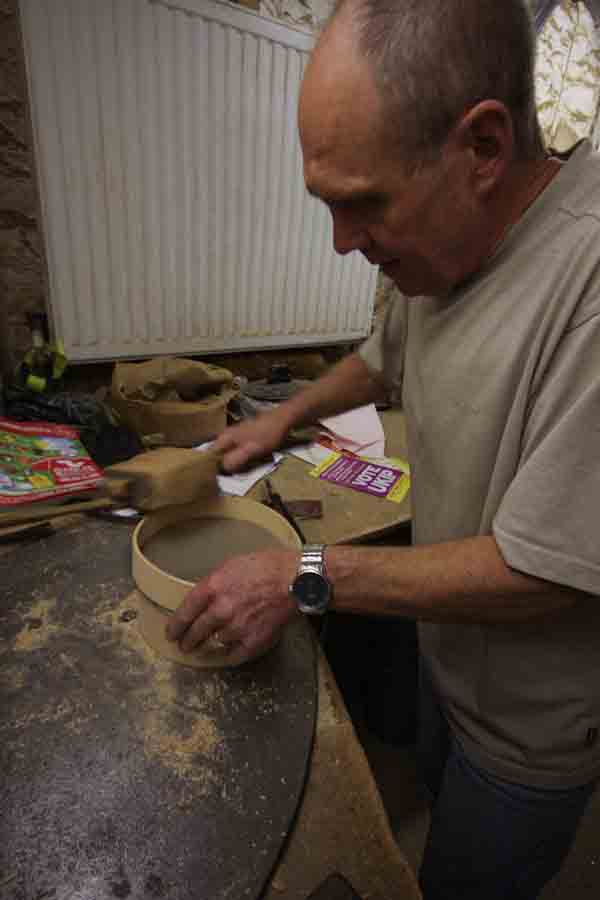
Regular readers of this blog will have seen Mike Turnock's workshop before and read about how he is the last sieve and riddle maker in the UK, steam bending wooden rims and weaving wire mesh sieves for gardeners, shellfish fishermen, cooks and potters.
The Heritage Craft Association have done much to help publicise Mike's work both nationally which has helped bring in more work and locally in the hope of finding someone suitable to take the business on. We are delighted to be able to report now that Mike has found a successor and so HCA can be proud to have played a part in saving our first Heritage Craft from extinction.
Damien Bramhall used to visit the workshop when he was a child and watch Mike and his father at work. he has been working as a lorry driver but was looking for a change of career when he read one of the press stories about Mike in the Buxton Advertiser. He got in touch, they came to a mutually convenient arrangement and Mike has already started training Damien up. Mike hopes to retire and pass the business on at the end of August. HCA are trying to help them find some funding to help cover the costs of the training since neither will be earning much whilst Mike is teaching and Damien learning.
I met with them yesterday and Mike was showing Damien how he makes the smaller kitchen sieves using prewoven stainless steel mesh. First he takes one of the small steam bent rims and fixes the ends together.
Then he cuts a circle of the stainless mesh.
and bends it round a former.
A strengthening wire is clipped to length
and the mesh wrapped around.
Now the mesh sits between the two steem bent rims and the whole lot is forced tightly together pulling the mesh taught.
A couple of tacks keep everything in place and the finished sieve should last a lifetime. I bought an almost identical one in an antique shop not so long ago.
To me it was an absolute delight seeing this old craft given a potential bright future since a visit to Mike's workshop 18 months ago played a crucial step in setting up the Heritage Crafts Association, pictures of that visit and the blog post here
Some of the press coverage from the last year
Guardian article here
and audio slideshow here
discussed in the House of Commons here
and Mike's website
Friday, 30 April 2010
Saturday, 24 April 2010
closure of New Entrants Training Scheme at Hereford
A couple of weeks ago Hereford College wrote to students part way through the 2 year long NETS training to tell them that funding had been withdrawn and the scheme would close in July. The trainees due to start in May and September have also been told the course will not go ahead.
The NETS training is an excellent scheme originally started by CoSIRA in the 1970s, it provided in post training in wheelwrighting, blacksmithing, upholstery, wood machining and thatching.
Trainees were most commonly taken on as an apprentice in a business and their training undertaken at Hereford under the NETS scheme. They did 12 weeks intensive skills training over a 2 year period.
HCA are very concerned about the loss of this facility which is symptomatic of the loss of craft skills training throughout further education provision. We are coordinating communication between the organisations concerned; the British Artists Blacksmiths Association, the Worshipful Companies of Blacksmiths and Wheelwrights, the Guild of traditional upholsterers and various other interested parties.
HCA trustees met last Saturday and discussed the issue of NETS closure we decided unanimously that we should do what we can to opose the closure and publicise the situation. We have written to Ian Peake the principle at Hereford expressing our concern and asking for various points of background information about the situation at Hereford. We will pass on any information as soon as we hear back and be putting out information to the press.
The NETS training is an excellent scheme originally started by CoSIRA in the 1970s, it provided in post training in wheelwrighting, blacksmithing, upholstery, wood machining and thatching.
Trainees were most commonly taken on as an apprentice in a business and their training undertaken at Hereford under the NETS scheme. They did 12 weeks intensive skills training over a 2 year period.
HCA are very concerned about the loss of this facility which is symptomatic of the loss of craft skills training throughout further education provision. We are coordinating communication between the organisations concerned; the British Artists Blacksmiths Association, the Worshipful Companies of Blacksmiths and Wheelwrights, the Guild of traditional upholsterers and various other interested parties.
HCA trustees met last Saturday and discussed the issue of NETS closure we decided unanimously that we should do what we can to opose the closure and publicise the situation. We have written to Ian Peake the principle at Hereford expressing our concern and asking for various points of background information about the situation at Hereford. We will pass on any information as soon as we hear back and be putting out information to the press.
Sunday, 18 April 2010
HCA planning for the future
Friday and Saturday were spent in London again.
Friday was meetings with charitable trusts who we hope may help fund the Heritage Crafts Association's work and also gave us good advice about how efficient, successful organisations work. Then after a night in a cheapy £35 hotel (a cellar room near Earls Court) it was back to our committee meeting rooms which are a stones throw away from Trafalgar Square, another cellar room but this one is free, loaned to us by a supporter.
After just over a years hard work we feel the Heritage Crafts Association is established as an organisation, we have good links with the various individual craft organisations and many good contacts within government and the charitable sector. We still have no money but as more folk are beginning to sign up to our friends scheme that is helping.
This committee meeting then focussed on revisiting our priorities for action. This is something we did last November when our prime priorities were advocacy work within Government and DCMS and holding a forum to bring all the various craft organisations together.
Now we are established we feel we can start to address some of the issues facing craftspeople more directly. Our key focus over the coming months will be on these issues. Broadly they are either about helping make businesses more viable with promotion and marketing help or about issues of passing skills on to the next generation.
We hope to create a database of traditional craftspeople working around the country. This we hope to make publicly available through a craft map which will be searchable by region or craft. We are already being asked regularly by journalists for details of craftspeople that they can do stories on and it would be good for this information to be more widely available so that say someone in Suffolk looking for a basketmaker or boatbuilder could easily find them. The research needed to create this database will also highlight any particularly endangered crafts so we may have an endangered list such as the rare breeds survival trust have. We also hope to run a course in internet marketing for craftspeople, we have many skills in this area within the HCA committee and with recent developments in web2 software it is easier than ever for craftspeople to sell their work direct to customers at retail price.
On the training side of things we wish to support the transmission or passing on of craft skills, especially in the most endangered crafts. There will never be one simple solution to training needs, different approaches will be needed for different crafts and situations. It was interesting to see from our online survey of craftspeople that only 8% of respondents came into their craft through traditional apprenticeship and over 50% were in one way or another self taught, perhaps drawing inspiration from having done a short course and read all they can on the subject. In each individual case we will hope to find ways of helping skilled craftspeople pass their skills on to new learners using methods that suit both parties.
We also discussed the closure of the excellent NETS training at Hereford and the cutting of Weave at Dundee and will be doing whatever we can to oppose and publicise these losses.
Friday was meetings with charitable trusts who we hope may help fund the Heritage Crafts Association's work and also gave us good advice about how efficient, successful organisations work. Then after a night in a cheapy £35 hotel (a cellar room near Earls Court) it was back to our committee meeting rooms which are a stones throw away from Trafalgar Square, another cellar room but this one is free, loaned to us by a supporter.
After just over a years hard work we feel the Heritage Crafts Association is established as an organisation, we have good links with the various individual craft organisations and many good contacts within government and the charitable sector. We still have no money but as more folk are beginning to sign up to our friends scheme that is helping.
This committee meeting then focussed on revisiting our priorities for action. This is something we did last November when our prime priorities were advocacy work within Government and DCMS and holding a forum to bring all the various craft organisations together.
Now we are established we feel we can start to address some of the issues facing craftspeople more directly. Our key focus over the coming months will be on these issues. Broadly they are either about helping make businesses more viable with promotion and marketing help or about issues of passing skills on to the next generation.
We hope to create a database of traditional craftspeople working around the country. This we hope to make publicly available through a craft map which will be searchable by region or craft. We are already being asked regularly by journalists for details of craftspeople that they can do stories on and it would be good for this information to be more widely available so that say someone in Suffolk looking for a basketmaker or boatbuilder could easily find them. The research needed to create this database will also highlight any particularly endangered crafts so we may have an endangered list such as the rare breeds survival trust have. We also hope to run a course in internet marketing for craftspeople, we have many skills in this area within the HCA committee and with recent developments in web2 software it is easier than ever for craftspeople to sell their work direct to customers at retail price.
On the training side of things we wish to support the transmission or passing on of craft skills, especially in the most endangered crafts. There will never be one simple solution to training needs, different approaches will be needed for different crafts and situations. It was interesting to see from our online survey of craftspeople that only 8% of respondents came into their craft through traditional apprenticeship and over 50% were in one way or another self taught, perhaps drawing inspiration from having done a short course and read all they can on the subject. In each individual case we will hope to find ways of helping skilled craftspeople pass their skills on to new learners using methods that suit both parties.
We also discussed the closure of the excellent NETS training at Hereford and the cutting of Weave at Dundee and will be doing whatever we can to oppose and publicise these losses.
Friday, 9 April 2010
kesurokai
In August Nicola and I are heading to Japan to work with traditional craftspeople there and learn about how they are working to share traditional skills. Nicola did her PhD looking at how traditional skills are exchanged in the UK and this will form part of her ongoing research, she is also doing publicity for the event and has a very informative blog. from which I have shamelessely stolen the post below.
Kesurokai meetings started in Japan in 1995, organised by the highly respected temple carpenter Sugimura san. His aim was to bring together different craftsmen who normally work remotely to exchange traditional craft techniques and knowledge.
These events serve not only the practical purpose of ensuring age-old skills are maintained, but also create a sense of community amongst the craftsmen, helping them maintain their businesses. The Kesurokai movement has around 1500 members in Japan and holds twice yearly meetings all over the country.
A friend just brought this web site to my attention which has some images from a Kesurokai meeting in 2006 which show just how large and well attended they are:
There are also some really superb videos on the web site showing how various woodworking tools are made.
Wednesday, 7 April 2010
English country pottery
We have a fantastic heritage of pottery in Britain with many threads. Medieval earthenware jugs are universally praised then there are gorgeous 18th century slipware dishes, the rise of industrial ceramics in the Staffordshire potteries, salt glazed stoneware in the 19th and early 20th C and finally the studio pottery movement and Bernard Leach's fusion of East and West.
I have recently been sent links to some great pottery videos that I wanted to share. I have a great love of old earthenware pottery and used to visit Roly Curtis at Littlethorpe potteries many years ago and dig clay and try to throw pots for fun. http://www.littlethorpepotteries.co.uk/curtis_tradition.asp
So on to the videos, the first one is Isaac Button the speed and ease of working are a joy to watch.
This one is not English though he has visited and learned from many of the best old English potters works very much in that tradition and is a keen supporter of British traditional crafts. Guy Wolff centering 50lb of clay.
and finishing the pot
I have recently been sent links to some great pottery videos that I wanted to share. I have a great love of old earthenware pottery and used to visit Roly Curtis at Littlethorpe potteries many years ago and dig clay and try to throw pots for fun. http://www.littlethorpepotteries.co.uk/curtis_tradition.asp
So on to the videos, the first one is Isaac Button the speed and ease of working are a joy to watch.
This one is not English though he has visited and learned from many of the best old English potters works very much in that tradition and is a keen supporter of British traditional crafts. Guy Wolff centering 50lb of clay.
and finishing the pot
Wednesday, 31 March 2010
is hard work bad or good?
It seems to me that as a society we are very confused about how we regard our physicality. In the past we had the Protestant work ethic which made hard work a moral and spiritual duty whether you liked it or not. William Morris in his Utopian novel News from Nowhere argued that there should be pleasure in hard work, his townsfolk take joy in heading out to the countryside to join in the physical graft of hay making. His fellow socialists suggested that whilst hard work may not always be pleasurable it should be done with pride for the good of the community.
It seems industrialisation has led to the increasing feeling that work is bad and hard hand labour is something to be minimised. Intellectual labour is more highly regarded and rewarded. There are other views though. I like this little traditional story so much I included it in my book about wooden bowl turning.
The Industrialist and the fisherman
A rich industrialist was horrified to find a fisherman lying comfortably beside his smoking his pipe.
“Why aren’t you out fishing?” asked the industrialist.
“I’ve caught enough fish for the day,” said the fisherman.
”Why don’t you catch some more?”
”What would I do with them?”
”Earn more money. Then you could have a motor fixed to your boat and go into deeper waters to catch more fish. That would bring you money to buy nylon nets, so more fish, more money. Soon you would have enough to buy two boats, even a fleet of boats. Then you would be a rich man like me!”
“What would I do then?” The fisherman asked.
”Then you could sit back and enjoy life!”
”What do you think I’m doing right now?”
All this thought about hard work came about whilst breaking rocks for a new path today. A passer by told me it looked like slave labour, I told him I was getting paid and enjoying it but I don't think he was convinced.
Folk regularly stop and watch me turning bowls on my foot powered lathe. "That looks hard work" they say and it is always said in the tone of voice that implies that hard work is undesirable. Yet I enjoy the physicality of my work and presumably these folk enjoy a physical challenge too since the path past my workshop leads steeply up hill and over Kinder Scout. But here is the difference. Physical graft it seems is a good think during our leisure hours and a bad thing in our work hours. How many people these days pay hefty gym fees and sweat for hours a week on machines but still think physical work is in some way degrading?
Dr Howard Garner's theory of multiple intelligences has gained wide acceptance for the idea that the view of intelligence based on IQ tests was far too narrow, that in fact we have many ways of being intelligent.
The Education world has taken this up in a big way but primarily as a narrowly focused teaching tool ie, this child is a kinesthetic learner so we must teach in a way that recognises that. What I would like to see is a more widespread recognition that there is no hierarchy and that being linguistically or numerically bright is not more intelligent than being musically or kinesthetically adept although it may mean you will earn more money.
In my own life I like to try to achieve a balance of physical and mental work. I get frustrated when I see one man walk along a road spraying circles around pot holes and another coming along and filling them. I feel the pot hole filler may benefit from being given the trust and training to make value judgments and the spray can man may benefit from a bit of graft. The work of a self employed craftsperson is one of those sadly rare jobs that allow use of mind body and soul, it's more about making a life than making a living.
It seems industrialisation has led to the increasing feeling that work is bad and hard hand labour is something to be minimised. Intellectual labour is more highly regarded and rewarded. There are other views though. I like this little traditional story so much I included it in my book about wooden bowl turning.
The Industrialist and the fisherman
A rich industrialist was horrified to find a fisherman lying comfortably beside his smoking his pipe.
“Why aren’t you out fishing?” asked the industrialist.
“I’ve caught enough fish for the day,” said the fisherman.
”Why don’t you catch some more?”
”What would I do with them?”
”Earn more money. Then you could have a motor fixed to your boat and go into deeper waters to catch more fish. That would bring you money to buy nylon nets, so more fish, more money. Soon you would have enough to buy two boats, even a fleet of boats. Then you would be a rich man like me!”
“What would I do then?” The fisherman asked.
”Then you could sit back and enjoy life!”
”What do you think I’m doing right now?”
All this thought about hard work came about whilst breaking rocks for a new path today. A passer by told me it looked like slave labour, I told him I was getting paid and enjoying it but I don't think he was convinced.
Folk regularly stop and watch me turning bowls on my foot powered lathe. "That looks hard work" they say and it is always said in the tone of voice that implies that hard work is undesirable. Yet I enjoy the physicality of my work and presumably these folk enjoy a physical challenge too since the path past my workshop leads steeply up hill and over Kinder Scout. But here is the difference. Physical graft it seems is a good think during our leisure hours and a bad thing in our work hours. How many people these days pay hefty gym fees and sweat for hours a week on machines but still think physical work is in some way degrading?
Dr Howard Garner's theory of multiple intelligences has gained wide acceptance for the idea that the view of intelligence based on IQ tests was far too narrow, that in fact we have many ways of being intelligent.
| Linguistic intelligence ("word smart"): | ||||||||||
| Logical-mathematical intelligence ("number/reasoning smart") | ||||||||||
| Spatial intelligence ("picture smart") | ||||||||||
| Bodily-Kinesthetic intelligence ("body smart") | ||||||||||
| Musical intelligence ("music smart") | ||||||||||
| Interpersonal intelligence ("people smart") | ||||||||||
| Intrapersonal intelligence ("self smart") | ||||||||||
| Naturalist intelligence ("nature smart") |
The Education world has taken this up in a big way but primarily as a narrowly focused teaching tool ie, this child is a kinesthetic learner so we must teach in a way that recognises that. What I would like to see is a more widespread recognition that there is no hierarchy and that being linguistically or numerically bright is not more intelligent than being musically or kinesthetically adept although it may mean you will earn more money.
In my own life I like to try to achieve a balance of physical and mental work. I get frustrated when I see one man walk along a road spraying circles around pot holes and another coming along and filling them. I feel the pot hole filler may benefit from being given the trust and training to make value judgments and the spray can man may benefit from a bit of graft. The work of a self employed craftsperson is one of those sadly rare jobs that allow use of mind body and soul, it's more about making a life than making a living.
Tuesday, 30 March 2010
traditional crafts on BBC news
Nice article on the BBC news website today.
http://news.bbc.co.uk/1/hi/business/8586172.stm
Mr Wood gave up his job as a National Trust forester in 1995 to become a professional woodworker, making traditional bowls and plates from local timber using a foot-powered lathe.
The last professional pole lathe bowl turner before him, George Lailey, died in 1958 without passing on his trade.
Mr Wood went out and researched the techniques of, what was then, a dead craft skill. He even had to learn how to make the tools he needed as none existed outside of a museum.
He calls himself a "self-directed learner" and says it is how many professional people in the crafts sector learn their trade.
Mr Wood does not want to see his craft die again, but as he operates as a sole trader there are not many incentives for him to take on an apprentice.
"In the first year the trainee would be a serious liability to my business. In the second year they would start to hold their own, but it's not until the third year that they would be useful to me. But then they'll probably leave to set up on their own," he says.
On the job training
The problem of finding new people to take on traditional crafts is not limited to the countryside.
There are three skilled workers at Ernest Wright & Son, a scissor making firm in Sheffield, all of whom are in their mid 60s.
They have told Nick Wright, who is the fifth generation of Wright to manage the company, that they can work for him for another five years but then they will retire.
Mr Wright cannot afford to take on trainees and keep paying his staff. He fears the company will fold if he cannot find replacements.
No apprentice schemes exist for scissor making. Mr Wright says the National Apprenticeship Service suggested he offer an engineering apprenticeship, but he thinks that would be unfair as that is not what the job entails.
Ernest Wright & Son is thought to be one of only two companies in the UK that make handmade scissors.
"It's a trade you learn on the job with the experts. And the three men working at Ernest Wright & Son are the experts," says Mr Wright.
Mr Wright thinks people should be offered the opportunity to pay to learn a skilled trade.
"In the past, people used to pay a company to be taken on as an apprentice. People pay to go to university so why not to do an apprenticeship?" he says.
"And it would mean they would be committed to the career so won't leave after five years having been trained up, leaving me with the same predicament."
Race against time
The problem of finding new people to take on traditional crafts is not limited to small firms either.
Alastair Simms, 47, makes wooden beer barrels for Wadworth & Co brewery in Devizes, Wiltshire.
He started as an apprentice on his 16th birthday. He is England's only master cooper.
It took Mr Simms 15 years to earn the title of "master" which in England means he has successfully trained an apprentice.
Mr Simms wants to pass on his skills but time could be running out.
"I'm 47 now so it's the right time to take on an apprentice. It takes four and a half years to train an apprentice but they will need a total of 10 years working with me to learn the trade properly," he says.
"The longer you can spend with a craftsman the better you will become yourself."
A coopering apprenticeship does not exist and the company has been told to offer a joinery one instead.
Craft skills
"There clearly seems to be a problem," says Felicity Woolf, director of UK operations with Creative and Cultural Skills, the sector skills council that looks after crafts.
"If companies and individuals were able to apply for a more generic "craft apprenticeship", and then work out what specific areas of training are needed for their specific craft, then that would be more flexible."
Creative and Cultural Skills is also launching an apprenticeship training service in April that promises to help small businesses in the sector cut through the bureaucracy of taking on a trainee.
"Less than 10% of people working came through an apprenticeship route. The vast majority are self-taught and most come into the sector aged between 25 and 30," says Robin Wood, who is also the chairman of the recently launched Heritage Crafts Association.
It works with agencies in the education and learning sectors to identify and support ways to making sure skills are passed through the generations.
A recent survey carried out by the HCA points out the training concerns of people working within the many industries that make up the sector.
Training provision for those who want to make a living through crafts or improve their skills seems to vary widely across the board.
For example, there are short courses and workshops for basketmakers, but little in the way of formal or structured learning, whereas City & Guilds and NVQ level qualifications are available for stoneworkers.
And those working in pottery and ceramics said degree courses in Scotland had already disappeared and that the rest of the UK was heading in the same direction.
Dying trades?
The survey also suggests that 54% of people working in the sector feel the skills within their craft are in danger of dying out.
The HCA feels that the crisis faced by many traditional craftspeople is largely due to the fact that their crafts fall outside the remit of the current support agencies.
In England, for example, the Crafts Council supports contemporary crafts, whilst English Heritage's remit is to protect the nation's buildings and monuments, not knowledge and skills, Mr Wood argues.
The lathe belonging to Mr Wood's predecessor, George Lailey, takes pride of place in the University of Reading's Museum of English Rural Life.
"Whilst the last guy is working the skill isn't classed as heritage, but when he dies it becomes heritage. Surely it's far, far, cheaper to keep the skill alive rather than trying to set up a facsimile of it in a museum."
http://news.bbc.co.uk/1/hi/business/8586172.stm
Mr Wood gave up his job as a National Trust forester in 1995 to become a professional woodworker, making traditional bowls and plates from local timber using a foot-powered lathe.
Mr Wood went out and researched the techniques of, what was then, a dead craft skill. He even had to learn how to make the tools he needed as none existed outside of a museum.
He calls himself a "self-directed learner" and says it is how many professional people in the crafts sector learn their trade.
Mr Wood does not want to see his craft die again, but as he operates as a sole trader there are not many incentives for him to take on an apprentice.
"In the first year the trainee would be a serious liability to my business. In the second year they would start to hold their own, but it's not until the third year that they would be useful to me. But then they'll probably leave to set up on their own," he says.
On the job training
The problem of finding new people to take on traditional crafts is not limited to the countryside.
There are three skilled workers at Ernest Wright & Son, a scissor making firm in Sheffield, all of whom are in their mid 60s.
| There are only two companies left in the UK that make scissors by hand |
Mr Wright cannot afford to take on trainees and keep paying his staff. He fears the company will fold if he cannot find replacements.
No apprentice schemes exist for scissor making. Mr Wright says the National Apprenticeship Service suggested he offer an engineering apprenticeship, but he thinks that would be unfair as that is not what the job entails.
Ernest Wright & Son is thought to be one of only two companies in the UK that make handmade scissors.
"It's a trade you learn on the job with the experts. And the three men working at Ernest Wright & Son are the experts," says Mr Wright.
| Alastair Simms, master cooper, Wadworth |
"In the past, people used to pay a company to be taken on as an apprentice. People pay to go to university so why not to do an apprenticeship?" he says.
"And it would mean they would be committed to the career so won't leave after five years having been trained up, leaving me with the same predicament."
Race against time
The problem of finding new people to take on traditional crafts is not limited to small firms either.
Alastair Simms, 47, makes wooden beer barrels for Wadworth & Co brewery in Devizes, Wiltshire.
| Alastair Simms is England's only master cooper |
It took Mr Simms 15 years to earn the title of "master" which in England means he has successfully trained an apprentice.
Mr Simms wants to pass on his skills but time could be running out.
"I'm 47 now so it's the right time to take on an apprentice. It takes four and a half years to train an apprentice but they will need a total of 10 years working with me to learn the trade properly," he says.
"The longer you can spend with a craftsman the better you will become yourself."
A coopering apprenticeship does not exist and the company has been told to offer a joinery one instead.
Craft skills
"There clearly seems to be a problem," says Felicity Woolf, director of UK operations with Creative and Cultural Skills, the sector skills council that looks after crafts.
| Robin Wood makes bowls on a foot-powered lathe |
Creative and Cultural Skills is also launching an apprenticeship training service in April that promises to help small businesses in the sector cut through the bureaucracy of taking on a trainee.
"Less than 10% of people working came through an apprenticeship route. The vast majority are self-taught and most come into the sector aged between 25 and 30," says Robin Wood, who is also the chairman of the recently launched Heritage Crafts Association.
It works with agencies in the education and learning sectors to identify and support ways to making sure skills are passed through the generations.
A recent survey carried out by the HCA points out the training concerns of people working within the many industries that make up the sector.
Training provision for those who want to make a living through crafts or improve their skills seems to vary widely across the board.
For example, there are short courses and workshops for basketmakers, but little in the way of formal or structured learning, whereas City & Guilds and NVQ level qualifications are available for stoneworkers.
And those working in pottery and ceramics said degree courses in Scotland had already disappeared and that the rest of the UK was heading in the same direction.
Dying trades?
The survey also suggests that 54% of people working in the sector feel the skills within their craft are in danger of dying out.
The HCA feels that the crisis faced by many traditional craftspeople is largely due to the fact that their crafts fall outside the remit of the current support agencies.
In England, for example, the Crafts Council supports contemporary crafts, whilst English Heritage's remit is to protect the nation's buildings and monuments, not knowledge and skills, Mr Wood argues.
The lathe belonging to Mr Wood's predecessor, George Lailey, takes pride of place in the University of Reading's Museum of English Rural Life.
"Whilst the last guy is working the skill isn't classed as heritage, but when he dies it becomes heritage. Surely it's far, far, cheaper to keep the skill alive rather than trying to set up a facsimile of it in a museum."
Subscribe to:
Posts (Atom)