Monday, 28 February 2011

What is Sloyd?

All of a sudden I have heard lots of folk talking about "sloyd". Like "utsushi" in my last post this is a foreign word which has many subtle meanings which are lost in the normal translation simply as "handcraft". This word I know a little more about though having spent some time in Sweden and teaching at the national handcraft school at Saterglantan.


Sloyd or slöjd in the 19th century could perhaps have been translated as handcraft though it seems most commonly applied to the woodwork and the wider range of home crafts including textiles etc tend to be called hemslöjd. Sloyd like craft had dual meanings of sleight of hand or crafty but the real change came in the late 19th century. Uno Cygnaeus introduced crafts or sloyd as a mandatory subject in the Finish school system. Later Otto Salomon developed the ideas further in Sweden and popularised them through his teachings at the international craft teachers school at Naas.


The idea of "educational sloyd" was that it was not vocational, it was taught as part of a holistic education in the same way that we teach physical education today to all students not as if they are going to be great athletes but because it benefits the whole person to take some exercise. So educational sloyd helped students develop in many ways. The learnt hand eye coordination obviously but also accuracy, learning the importance of quality in workmanship and learning to understand and honour handwork and physical labour even if they were bound for desk jobs themselves. There are many parts of Salomon's teachings which I used when developing my own teaching methods for my spoon carving courses. He broke down woodworking into a series of very simple steps that could be mastered in turn. First using a tool in a particular way, then doing a simple project, then progressing to slightly more complex methods and projects.

Today sloyd is most commonly associated with free carving with axe and knife but most of Salomon's teaching was what we would call bench joinery. He was I believe the first to start by teaching the making of joints on practice pieces, progressing from simple to complex joints. This was still being taught in woodwork classes in UK schools in the 1980's and still survives in city and guilds woodwork teaching. Not many folk know that those techniques of teaching came originally from Naas. A great many UK teachers went to Naas in the late 19th and early 20th century so much so that the word sloyd is used commonly in educational writing in English at the time and there is never need to explain it, people knew what it meant. In 1892 S Barter published "Woodwork, the English Sloyd" free download here which was an adaptation of the Naas system created in association with the City and Guilds. Salomon's "teachers handbook of Sloyd"   used to sell for silly money but was reprinted a few years ago so I finally got a copy and it is now available free online here.

Sadly over the years the original concept of sloyd teaching as good wholesome practice that benefited the whole person was eroded. By the time I was at school woodwork classes whilst still following much of the basics of Salomon's methods had become primarily vocational. If you were academically intelligent you did academic subjects and if you weren't well then you chose between woodwork and metalwork. Once it was established that this was vocational rather than holistic education it took a short time to look what people were doing in industry and out went dovetails and timber to be replaced by biscuit joints then MDF. Very soon "craft design and technology" became "design and technology" did anyone notice that happen? when was it? it was certainly within the last 10 years and now DT is about designing stuff to be cut out by laser cutters and made by injection moulders. It has become one more subject where kids sit down at computers instead of using their hands on real raw materials to make something.


The only place I have seen making a real difference is Ruskin Mill Educational Trust. They do wonderful things with their students but it is sad it is not mainstream education. So educational sloyd was not about handcraft or making stuff. It was a pedagogical theory (pedagog is a wonderful word which is used a lot by Swedes) it was about going through a process of teaching which had a profound effect on the student. I think many of us who teach craft skills well see regularly what a profound effect it can have when people discover they can use a tool well, and having perhaps struggled and persevered they master some difficult technique. I love sharing in that experience, it only comes when you allow the student to work on their own, don't do it for them, do all you can to make the process smooth, good sharp tools, good raw material, a little gentle advice here and there, check they are safe and making progress, encourage when the going is tough and finally share in the joy and sense of achievement. I do love my job.


I see all this as being parallel to cookery teaching in schools. There was a stage when kids were designing ready meals and deciding what made a healthy pizza without somehow ever making the pizza. Jamie Oliver made a huge difference there and we need to do the same with craft teaching. Get back to simple tools and real raw materials because that is where children learn most and are empowered. There is nothing empowering about using a laser cutter however perfect the result. I suspect the flush of "sloyd" on the web is due to Roy Underhill my friend Sean Hellman just posted a link to this episode of his woodwrights shop program. There can be little doubt the source of the material for the episode was another friend Doug Stowe who has a nice blog called "the wisdom of hands" we correspond on the subject of sloyd and he wrote a few good articles 5 years ago in the US woodwork press. Roy puts it across well though and great to get it out to a wide audience.


Sunday, 13 February 2011

The last glass eye maker

From The Times online

"IN A SMALL room overlooking a quiet North London street, Jost Haas sits in a white coat at a cluttered table, delicately blowing into a glass tube until a ball bubbles out from the end. Using skills unchanged for 170 years, he is making an artificial eye such as those that stare unseeing from a wooden tray at his elbow.

It is 35 years since Haas left Germany and brought his wife, Ulla, to this house in Mill Hill, where they raised a daughter. At that time Britain needed two or three glass-eye makers, who, because of the traditional skills used there, usually came from Germany. Now 66-year-old Haas is the only one. When he decides to retire, continuation of the craft here will almost certainly depend on whether a successor can be found from his native country."


The Glass Eye Maker from Tomas Leach on Vimeo.


http://www.timesonline.co.uk/tol/life_and_style/health/article864693.ece

Friday, 11 February 2011

1000 years of traditional crafts at Lincoln

A Thousand Years of Traditional Crafts at Lincoln Castle and Cathedral
Saturday, 21 May, 2011

This is a nice opportunity to show off your traditional craft at Lincoln. No demonstration fees are available and stands are limited and filling quickly so book soon if you want to go. The event ties in with the major international conference of the Preservation Trades Network. HCA will have a stand in the Nave of the Cathedral.  This is the info sent from Lincoln Cathedral....

Together, the Castle and Cathedral have been working on a new event that we intend should be both big and exciting and that aims to raise the profile of heritage skills in Lincolnshire and beyond.

Lincolnshire County Council (LCC) and the Cathedral have increasingly been working together on the heritage skills agenda; so far we’ve obtained Lottery funding to run a bursary scheme over the next five years in joinery, masonry and lead work, and European funding to build a Heritage Skills Centre at Lincoln Castle due to be completed mid 2012.

The work done to date shows that the public are enormously interested and supportive of our plans and this has encouraged us to put on an event that gives people the opportunity to see heritage skills in action. Demonstrations will be absolutely key to the event, whether it be mud and stud, stonemasonry, thatching, blacksmithing or the myriad other skills to be found in the East Midlands. This event is all about ‘showing off’ and making people realise how important these skills are. As someone who is involved in heritage skills we hope you will be interested in demonstrating at this event.

Key points of the day are as follows:
Joint ticket to cover both Castle and Cathedral – first time ever!
Cathedral Workshop will be open to view
Demonstrators in the Cathedral nave (clean only), Castle grounds in marquees and in the Castle Prison where there are 40 cell units which are clean, dry and have lighting (power sockets more problematic)
Have-a-Go activities for Children
Tastes of Lincolnshire food stalls will be placed through the Castle grounds and Castle Square – adding to the attraction of the event

We are used to running large events like this, for example our Sausage Festival at the Castle attracts some 9,500 visitors, and we have planned an extensive promotional campaign to ensure the success of the day for both us and the skills people.

If you would like to attend or just like to know more about the event, contact Penney Francis  Penney.Francis@lincolnshire.gov.uk

Monday, 7 February 2011

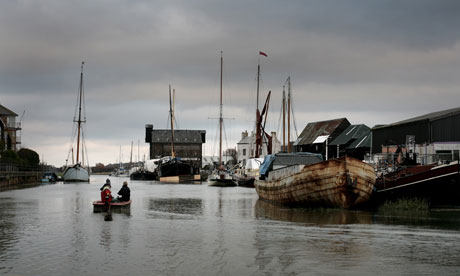
please sign petition to save traditional boatbuilding site.

I have written about Standard Quay at Faversham before here 
and there was a good article in the Guardian here

Now is your chance in just a few seconds to help save this historic dockyard for the purpose it was intended. Simply follow this link and sign the epetition to show the local council that folk across the country and around the world value this part of our heritage.

Click here to go to the petition
All you need do is enter name, address and email. What is important is that after signing the petition you will be sent an email to confirm your email address and you need to open it and click the confirm signature link in order for you to be registered. As of today they have 128 signatures but I think that a lot of folk care enough about it to give it a few seconds of their time.

Monday, 31 January 2011

Made in London


This is a project by film maker turned photographer Tim Clements, the photos are copyright but Tim is a fan of HCA and has kindly let us share them with you. 

This is Tim's explanation of the project
"I am making a series of 50 photographs celebrating independent Trades and Crafts People who make a living from their trade in London. As you can see in the Gallery, it is on going. I am photographing both the well known and the unknown. All involved have a passion for what they do and are very proud to make a living from what they do. But the fact they are all independent and often one-man-band businesses makes them vulnerable." Much  more on his website.

The Tailor: Timothy Everest is holding a pair of shears made by Ernest Wright of Sheffield, held in front of a dummy made by Kennett & Lindsell of Essex. He is wearing a suit of Porter & Harding wool, cut by Annika Caswell, who you can see in the portrait below. Apprenticed to the legendary Tommy Nutter (tailor to The Beatles) Timothy prides himself on the quirky but traditional craft of his work that Tommy inspired. While the suit Timothy Everest’s customers leave with can only have come from his shop, the customer also leaves with the memory of a unique customer experience, for Everest is at the forefront of the be-spoke movement. The quality of a transaction is not something we give much thought to now. We seem resigned to elbow our way through crowds at large stores, accept indifferent service with an indifferent shrug, and we expect the sales person to know absolutely nothing about the product they are selling. Sometimes its only when we experience the opposite of this kind of transaction that we realise how negatively bad service actually affects us. www.timothyeverest.co.uk

The shoe last maker, recent photo text to follow.


 The Shoe Maker: After seeing the film Hans Christian Andersen as a young boy, Sebastian Tarek fell in love with the idea of shoemaking. Years later after completing his formal training at Cordwainers Technical College, he went home to see his family and celebrate. On hearing Sebastian’s news his Polish grandmother told him: “Your great grandfather would have been so proud”. Why my great grandfather? he thought. To Sebastian’s complete astonishment, she told him that his great grandfather had made shoes for the Czar of Russia and was the last in line of eighteen generations of shoemakers. No one had ever mentioned it. Ten years on as a be-spoke shoemaker, he is seeing a decline in his craft. Be-spoke shoes are beyond most of our pockets now, though they are increasingly popular among the lucky few who can afford them. This demand, in combination with ready to wear handmade shoes in shops, which allows shoemakers to freelance their skills, means there’s just enough work for Sebastian to pursue his dream. www.sebastiantarek.com

The Violin Maker: John Dilworth has made violins for 34 years and is a Master Luthier, one of a handful in London. John was trained at Newark School of Violin Making and apprenticed at the Beare’s violin makers where he learnt the art of restoration. He considers the vocational education he experienced more useful than anything he could have learnt at University and in return, John is proud to say he has trained with great success a few of apprentices of his own. Restoration is a crucial part of John’s work, even when making a new instrument. “For most violinists, the instrument they would most covet would be an 18th century Italian, and most makers since then have been doing their best to rediscover the methods that made them”. John is a master maker of “new old” violins, and has even made his own unique varnish to emulate the look and the sound, yes the sound, of classic violins. “The important point is that the varnish should not mute the instrument in any way” he says. It really is down to millimeters. www.johndilworthviolins.co.uk
 
The Saw Doctor: Bill is checking the set of the teeth on a third generation steel logging saw, handed down father to son. To his customer this saw is more than just a saw. It is not just something bought on a frustrating, forgettable day from B&Q. It is a memory of a father and a grandfather. A memory of large, grease etched hands, the sound of a laugh, the tune of a whistle. A direct, tangible link to the past. And taking the saw to Bill and having a chat is another moment added to the provenance of this saw. This saw is also “green”. The teeth on a mass production saw are specially hardened so, ironically, they last longer, but once they are blunt they can not be sharpened and the saw has to be thrown away. So it can not last as long as this old saw, whilst someone is here to sharpen it. Bill was taught by his father Peter in his workshop in Earlsfield and has been a Saw Doctor there for 30 years. Nobody is set to take his place www.austinmowers.com


Tim says

"Independent crafts and trades people are a great barometer for both the cultural and economic health of a place and an excellent measure of its spirit. This project intends to remind us of the importance of independent trades and craft people today and in the future "


Tim is still looking for more London based craft businesses to photograph so if you know any suitable folk that could use a little publicity let Tim know, either via his website or contact HCA and we'll pass details on.

Saturday, 29 January 2011

Farnham Pottery under threat

In the UK our heritage of historic buildings is recognised, protected and promoted but the living heritage associated with those buildings is not, only the dead fabric of the buildings as this case will show.

Pottery has been made at Farnham from Roman times and the 16th century saw large scale production for the London market. The current pottery was built in 1872 by Absalom Harris and five generations of the Harris family ran the pottery business until production finally ceased in 2000.
The Pottery operated its own clay pits, had four working kilns and employed up to 30 men. The Queen Mother and Gertrude Jekyll were customers.

The pottery was purchased in 1998 by the Farnham Building Preservation Trust, it is grade II listed and considerable sums of public money have been spent on preserving the fabric of the buildings. So what happens next? The buildings preservation trust and English Heritage have fulfilled their remits of protecting the fabric of the building and are now considering selling the buildings on which could mean development as retail premises or whatever the highest bidder chose to do.

There is a second Trust involved with the site, the Farnham Pottery Trust  They would like to see the pottery functioning as a working pottery with an educational function.  Currently part of the pottery site is used for adult education in ceramics (not the traditional products of the site) whilst other parts are used as a retail outlet/farm shop.


There is clearly still demand for the architectural and horticultural work that the pottery used to produce. Mick Pinner worked at the pottery untill it closed in 2000 and now makes similar work at the nearby West Meon Pottery. specialising in restorative architectural ceramics using traditional methods.  One of his main issues is lack of available skilled workers to assist him.  He is also passionate about the history of Farnham Pottery and ensuring it's sustainable future in the local economy.


If the Farnham Pottery Trust are successful in keeping a lease on the site their plans for the future include;
  • Mick developing a short course which focuses on ceramics produced by Farnham Pottery which are unique to production there to include finials, decorative pieces, chimney pots etc. 
  •  Original press mouldings are retained at the pottery. These can be reproduced and a course designed around using the moulds.  A skill which in the next few decades will surely disappear from our heritage for good.
  •  Retail outlet - Promotion of work at West Meon Pottery, reproduction pieces from Farnham Pottery, souvenir pieces relating to pottery (using original sprig moulds?)
  •  Skills based training.  Trying to establish skills based training which has been slowly removed from current curriculum.  Provide a specialist centre for skills based ceramic learning to preserve the art of making. 
  • Exhibition/Display/Demo space - An exhibition, tour of locality and demonstrations of heritage production techniques."


It seems a shame that the living cultural heritage of the pottery was not recognised in 2000, only the value of the buildings fabric. We see this again and again see Portland Works, Standard Quay, JW Evans and to see the benefit of valuing cultural heritage see Honister slate mine.
 

It seems ironic that Farnham Pottery is in in the consituency of Jermy Hunt the culture secretary.

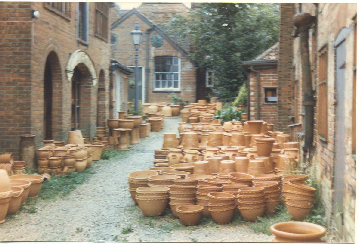
Lets finish with some lovely old pics of the pottery from the 1960s.


I really like this method of using a stick poked into a pile of clay to show where the rim of the pot will come to, a very simple but fast way of achieving consistency. I used to watch Roly Curtis at the very similar Littlethorp Potteries near Ripon doing just the same.


Tuesday, 25 January 2011

Balvenie Masters of Craft awards


The Balvenie has launched The Balvenie Masters of Craft awards, celebrating handcrafted goods from across the country.

The awards scheme aims to shine a light on the talent in the field of handcrafts - working with metal, leather, wood, stone, food and drink, glass and ceramics and textiles. It is not a history project - youthful exuberance is helping to drive these skills on and making them relevant in the 21st century and commercially viable.

Joining HCA Chair Robin Wood on the judging panel is Kevin McCloud, the presenter of Channel 4’s Grand Designs. Kevin has employed craftsmen in his design business, and witnessed their skill on the set of Grand Designs. It is, he says, “an enormous privilege” to watch a craftsman at work. But he is concerned for the future. “We have lost touch with the value of things,” he says. “We don’t understand the skills required to make things anymore.”

Kevin feels it is time to honour our craftsmen. “When we talk about value these days we talk about money don’t we? Rather than time and gifts, love and commitment. So I think the idea of being able to champion craftsmanship, to thank craftsmen, promote them, to show off whatever disciplines there are – leather, metal, wood – is hugely important.”