Monday, 14 November 2011

building the world's most iconic viking ship, part 1

HCA's chair Robin Wood visits Norway...

In 1903 a Norwegian farmer dug into a mound in one of his fields and made a discovery which archaeologists rate as comparable in importance to the grave of Tutankhamun. The Oseberg farm is 60 miles south of Oslo outside the town of Tonsberg and for years Oscar Rom had wondered what lay under the mound in his field, people said it was haunted and that it contained graves from the black death. Soon after he started digging he came across some highly carved wood and contacted archaeologists. The whole mound was excavated in 1905/5 revealing the earliest, the most complete and most beautiful Viking ship to survive. The burial mound contained many high status grave goods and the bodies of two women all of which shed  much light on Viking life but for now I want to concentrate on the ship itself.

The ship was preserved and is displayed in the wonderful Viking Ship Museum at Oslo.
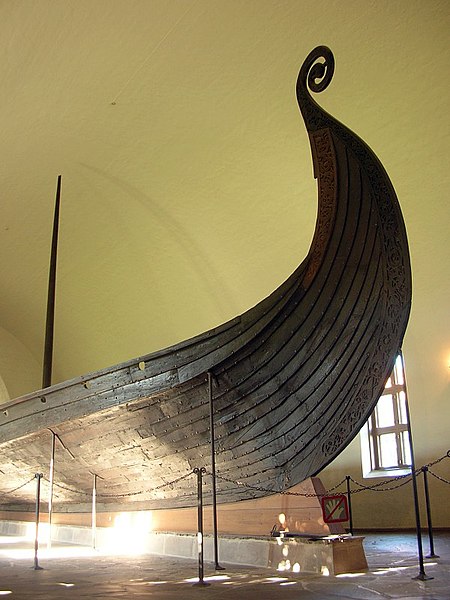
On June17th 2010 a new era in the exciting history of this ship began with a project to build an exact replica using the same tools and techniques as were used to build the original. As soon as I heard about the project I knew I had to visit and hopefully work on the ship. An internet friend Tim Allen had been volunteering on the worksite and put me in contact with the New Oseberg Ship Foundation arrangements were made and last week I spent 4 days working on this most remarkable of building sites. My camera cards are bursting with pictures so I'll do a few posts starting with the raw material.

The ship is built entirely of cleft and hewn oak, no saws were used. The trees by modern standards were impressive fat tall and straight grained, a foresters or saw-millers dream. Here are a couple of typical trees for the project with the part built ship in the background. Trees of this quality have proved impossible to source in Norway so most of the planking trees have come from Denmark. The oak for the keel, the backbone of the ship was however felled locally.


This is Thomas Finderup who built the 4 large replica viking ships at the famous Roskilde viking ship museum in Denmark. Nobody alive knows more about Viking shipbuilding or tools.

The trees are split with hammers and wedges, first in half then quarters, eighths and finally sixteenths, the last is the hardest split to get to run true. Whenever you split wood if you get exactly even amounts of wood either side of your slit it is more likely to run true and straight, get it wrong and the split will "run out" leaving you with one heavy thick chunk and one too thin to use. The important thing is to get as wide a plank as possible by avoiding the split running out as it heads toward the thin centre. To do this the shipwrights start by cleaning a 2" wide flat at the centre of the tree scoring a centre line down this with a chisel and then inserting small wooden wedges. Only then do they start opening up the split with metal wedges knocked in from the end, this is Gregorius.


And once they are happy they let visitors who's skill level they are not yet sure about have a go :0)


This split started to run off on the underside so we started again from the far end, this time it ran true. It was worth taking the time as the original tree was nearly £1000 and would yield just 16 of the widest planks.

once the split is going well you can use a bit more force, Tim with the big mell.

The thick wedge this produces is then hewn down to a single plank with a axe, planed, steamed, fitted and finally riveted into place with iron boat nails. More on that in the following posts. I'll also post about the organisation and running of the project and the gorgeous replica axes and other tools. Cleaving timber for ships like this died out, Thomas told me, in the 1200s, we can clearly see that the timbers of earlier ships were cleft and later they were sawn but the art of cleaving wide long boards for shipbuilding was completely lost for 800 years. Thomas and the team from Roskilde developed their way of working but no-one really knows exactly how the Vikings did it.

more old woodworking films

first a nice new one about rakemakers the Rudd family in Cumbria.


16 TEETH - Cumbria's last traditional rakemakers from Rii Schroer on Vimeo.

and some old ones about sussex trug making, first in colour from 1963


TRUGS


and then back to 1929

BASKET MEN OF SUSSEX


and finally Irish coracle making, nice shots at the end of using them for fishing.

A BYGONE CRAFT

Thursday, 3 November 2011

major crafts research goes ahead

A major new research project promisses to shed light on the UK traditional craft sector for the first time.

When we started the Heritage Crafts Association 2 1/2 years ago one of our first objectives was to properly map the sector, to find out which crafts were endangered, which were doing well and which offered potential for growth. In fact it was the first objective in my wish list back in Jan 2009.  We were told that to do this job properly would cost between £50,000 and £100,000 not the sort of money we had handy as a new charity.

After 2 years of gentle advocacy we were delighted when Skills Minister John Hayes announced that he would find funds for just the research we had been asking for.  HCA were part of the interview panel and we are delighted that Trends Business Research Ltd have now been appointed to undertake this major project. The final report is due to be completed by next March and a whole lot of work has to be completed by then, creating a database of as many practicing craftspeople as possible will be key and we hope HCA friends and followers will be able to help us spread t=he word when the time comes.


What good will it do?


Well we have lots of anecdotal evidence that there are certain issues within our sector. eg elderly skilled craftspeople not able to pass on their skills to a following generation, lack of entry routes for young people to start in a career etc.


The stories we have collected have been enough to convince many people there is a real problem but in order to access funding to address the issues we need more proof of the size and nature of the situation, genuine research will also help us see clearly where the most pressing issues are and prioritise action. It will also be great to help publicise the fantastic work that does go on within the traditional craft sector which has often played second fiddle to the better funded innovative contemporary crafts.

Monday, 24 October 2011

new TV "Ade in Britain"

Following the BBCs "made in Britain" we can now look forward to TV funnyman Ade Edmonson traveling the country discovering regional traditions, crafts and cooking in "Ade in Britain"

"Ade Edmonson takes a culinary road trip around Britain revealing the eccentricities and character of each region through their most celebrated dishes. Indulging in his love for both cookery and British culture, Ade takes to his iconic Land Rover to meet the producers and farmers behind many famous local delicacies. He also takes part in regional traditions and customs from Morris dancing to cheese rolling along the way. Each of Ade’s funny and insightful journeys culminates in a scrumptious feast whipped up on his trusty mobile kitchen to celebrate each area’s unique food heritage. "

Press pack is embargoed until 1st Nov but if you google there is plenty of info out there already.

Ade seems to be going for something of a culinary Fred Dibnah look, he was in Bakewell to check out Bakewell puddings.

And Just down the road from me at Eyam school to see well dressing.
The main focus of the show looks to be food traditions, from Melton Mobray pies to Yorkshire puds but we also know he tried his hand at thatching and clogmaking and eel catching .
Cool mini and foodie trailer 

Watch the trailer here

It was nice to see the cockle pickers using Hill and Sons riddles although I also saw a craft I have a real problem with Welsh love spoons (lots of tacky trash sold on the back of made up Victorian tradition whilst the wonderful tradition of cawl spoons is overlooked)

Great to see more British traditions on the TV though for me Ade will always be Vivyan.


Sunday, 16 October 2011

Grayson Perry Tomb of the Unknown Craftsman

As the only person working in a craft medium to be taken seriously by the art world and having won the Turner Prize Grayson Perry is often outspoken, entertaining and thought provoking. He famously said the Art world found it easier to accept the fact that he was a transvestite than that he made pots. He wrote a well argued piece in 2005 describing the contemporary craft scene as "a refuge for artists who play it safe"
He does have a lot of respect though for well made traditional craftwork and so I was quite excited when I heard that he would be having a show at the British Museum titled "the tomb of the unknown craftsman" This surely I thought references Soetsu Yanagi's great book "The unknown Craftsman" and given that the British Museum itself is a temple to the best unknown craftsmen of ages past from around the world I was expecting an homage to those craftspeople, perhaps something that brought the objects to life again.
On my way into the museum I paused in room 24 which is themed "living and dying" it's a room I have spent time in before and has magnificent artifacts varying from Inuit hunting implements and clothing to one of the wonderful Easter Island sculptures. Here are just a few of the wonderful items on display. A Maori food bowl, the carving on the underside particularly special. 


An axe from the Solomon Islands early 20th C. Clearly an English Kent pattern head I have re-handled many of these but always in rather more utilitarian fashion.

 Solomon islands food bowl.

 Haida carving.


and moving into the great court a magnificent Haida house frontal pole  


the Haida people and all North West Coast carvers are truly one of the great woodworking cultures of the world, the design and craftsmanship are just wonderful, look at the toolmarks here, no sandpaper, a thousand precise cuts with sharp tools.


 So back to Grayson at the entrance to the exhibition is his glorious AM1 motorcycle.

 Inside we were not allowed to take photos. Did I find my unknown craftspeople brought to life? Well sadly no. I did find a good retrospective of Grayson's work and dotted alongside it were pieces of work from the museums collection which felt like they were there to give understanding, comparison and credibility to Grayson's pieces, I didn't really get any feeling that Grayson's works were in any way helping me to better understand the museum pieces. The museum pieces had very minimal interpretation, so for instance of my favourite pieces was labled

"Bonnet, Samoa, early 1800's Turtle shell and cotton"

I learned nothing of the context the object came from, the people who made it, when such an incredible thing was worn etc. maybe that is the job of a museum not an art exhibition. Amongst Grayson's work it was interesting to see a wide range of his big pots but I was most taken by his cast iron sculptures and two in particular from 2007 titled our father and our mother, strange pilgrim figures with their worldly goods on their backs. The tomb itself was also a large cast iron sculpture of a ship adorned with casts of objects from the BM collections, some how it didn't grab me, I went back out for another look at the Haida pole.

Maybe what I like best about Grayson is actually his writing, I enjoy the blog allegedly written by his teddy bear/god figure Alan Measles often ireverant and thought provoking. This is what he had to say at the end of the exhibition on Craftsmanship.


"Craftsmanship is often equated with precision but I think there is more to it. I feel it is more important to have a long and sympathetic hands-on relationship with materials. A relaxed, humble, ever-curious love of stuff is central to my idea of being an artist. An important quality of great art of the past was the pure skill in the artists use of materials. In celebrating craftsmanship I also salute artists, well most of them."


Thursday, 13 October 2011

Two Heritage Crafts Marsh Awards will be presented at the V&A next March. The first award recognises someone who has worked to pass craft skills on to the next generation. The second award is to recognise a volunteer who has done a lot to promote their craft through one of our many craft associations. Please apply or recommend someone here http://www.heritagecrafts.org.uk/marshawards.html
We initiated these awards to help raise the profile of the valuable work that many folk are already doing within the traditional crafts, we hope you will help us do that by letting us know about suitable worthy people. As well as the kudos of the award you get a cheque for £500.
Alex Langlands from BBCs Victorian Farm will be helping us pick the winners.
Only a couple of weeks left to get applications in.

Sunday, 9 October 2011

UK Parliamentary Group recomend my work

The all Part Parliamentary Manufacturing Group is an initiative of Vince Cable to highlight the great manufacturing that still goes on in the UK. Each MP is asked to recommend local manufacturers that we can be proud of.
I am delighted that my MP Andrew Bingham has recommended not only myself but fellow craft business Hill and Sons riddle and sieve-makers. Here we are on the official website


I get a picture of a bowl and spoon and bit of blurb
"Robin Wood turns wooden bowls on a foot powered lathe. The craft is 2000 years old and died out in 1958. Mr. Wood revived it and then taught the skill to people in the UK, USA, Sweden and Japan. He has supplied the Globe Theatre, Hampton Court Palace and the Tower of London with his product. He also supplied props for the Ridley Scott film Robin Hood as well as exporting all over the world."

It would be nice to say it's great to be recognised for the work I do but the truth is it is shameless self promotion. When I heard about the scheme we tried to encourage other craftspeople through the HCA to recommend their MP put forward traditional craft businesses. I visited my MP at one of his regular surgeries and suggested he put forward a local craft and gave him some names including myself and Hill and Sons, he put us both forward. Over half the MPs have not made a recomendation yet so there is still time to suggest to your MP that they could put forward a traditional craft business. Stick your postcode in here to see is your MP has done it yet and if s/he has not wizz them an email.