Thursday, 21 February 2013

Marsh Heritage Crafts Awards

Marsh Heritage Crafts Awards Shortlist Announced

The Heritage Crafts Association and the Marsh Chrristian Trust announce the short list for the second Marsh Heritage Crraft Awards.

For the Marsh Heritage Crafts Trainer Award, the short list is:


Phil Barnes (enamel)

Tracy Franklin (goldwork embroidery)

Cameron Maxfield (silversmith)


For the Marsh Heritage Crafts Volunteer Award, the shortlist is:

Anna Atkins (weaving at Farfield Mill)

Angela Brown (lace)

Brian Hill (silversmithing)


The winners will be announced at the Heritage Crafts Association Spring Conference 2013: Manifesto for Making - tickets are on sale now, and I hope to meet you there, at the V&A on Saturday 23rd March.


Pat Reynolds - Heritage Crafts Association Adminisrator

clog amnesty and the last clogmakers


Clogmaking is in the press again even making the Radio 4 Today program this morning. The story as reported goes like this, there is a resurgence of interest in Welsh clog dancing but not enough clogs. There is only one clogmaker left in Wales and the craft may die out, there is even a clog amnesty to get people to hand in their old clogs. One newspaper is reporting that this amnesty is somehow going to fund an apprentice clogmaker though the official amnesty page makes no mention of that, and it is difficult to see how it would generate the sort of funds needed.

The true story as is often the case is much more interesting and much deeper. There are in fact quite a few folk making clogs but most use machine cut clog soles sawn on a bandsaw. We should point out here that English and Welsh clogs have always been a wooden sole with a leather upper unlike the French, Spanish or Dutch clogs and sabbots which are all wood, they are also far more comfortable. The most difficult bit of this traditional craft and the bit that people lay claim to being "the last of" is cutting the clog sole with long handles clog knives. You use a set of three knives, the blocker, for most of the shaping, the hollower, to hollow where your foot sits and the gripper, to cut the groove the leather upper gets nailed into.

For many years the only person in the UK who was making all his clogs in this traditional way was Jeremy Atkinson  who we have written about before here  Jeremy spent 25 years researching the craft working with the last retired clogmakers in Wales, visiting working clogmakers in Spain he even wrote the book on clogmaking back in 1984 .
Here he is in the workshop


More recently one of the clogmakers who uses bandsawn soles Trefor Owen has also started demonstrating some cutting with knives and gaining a lot of press as "the last full time clogmaker in Wales"
Here he is


Journalists love to tell the story of the last craftsman on the verge of dying out, it is at the same time compelling and frustrating. It is frustrating because it is a self fulfilling prophecy. So long as there is big national publicity to be gained from being the last one about to die out there is very little incentive to train someone else to work as competition. I know this all too well having taught many people to turn wooden bowls on a pole lathe journalists desperately want to print that I am "the last working pole lathe turner". Occasionally I will tell them that I am still "the last person earning the majority of my income from making bowls on a pole lathe" but surely the fact that there were no pole lathe bowl turners 25 years ago and now there are probably 50 that can do it in the UK and others I have taught in Japan, Sweden the USA and across Europe is a far more interesting story? Apparently not what sells papers and Radio is the last of the line story. How then do we encourage people to take on an apprentice?

In 2005 Jeremy Atkinson did actually train a clogmaker Geraint Parfitt at St Fagans the Welsh National folk museum at Cardiff where he is still working today. This film shows some of the that process.


Through the Heritage Crafts Association we are working hard to adress the current issue of lack of entry routes to the traditional crafts. Getting journalists interested in the current upsurge in interest rather than the last of the line is key. What we are experiencing is not the end it is the beginning, a little like the upsurge in interest in rare breeds, locally sourced and organic food over the last 20 years, people want to buy these things and young people want to find fulfilling work there is a rosy future ahead.

Wednesday, 20 February 2013

amazing art/craft by Hubert Duprat and the Caddis

I just found these images and fell in love.

The French artist/sculptor Hubert Duprat gives caddis fly larvae gold to build their tubular cases with, they are so beautiful.


Here is the artist discussing his work, he describes the caddis project starting at 2.30. I like the way he describes it as a collaborative project with himself as the architect and the caddis as the builders.

Thursday, 14 February 2013

stone carvers wanted for TV film project


Award winning documentary film house, Providence Pictures, is seeking experts to contribute to a NOVA/PBS film series — Building Wonders of the World
Drawing on the successful formula of Providence Pictures’ last three films — Secrets of the ParthenonRiddles of the Sphinx, and Building the Great Cathedrals — our new three-part documentary film series, Building Wonders of the World, will utilize a combination of classic detective story archaeology and an immersive, hands-on construction demonstration.  
For our current project we are looking to recreate a piece of historical architecture based on the rock-cut tombs of Petra. The purpose of this model is to test out ancient methods of building by using academic knowledge to create a one-of-a-kind experimental example of how certain tools and techniques work in reality. Ideally the “tomb” will stand about 4m high and 3m wide and be made of sandstone. We have scholars who know the ancient engineering details of such a project, but we need someone who can creatively execute the project using sculpting and carving expertise.
It is important to investigate the appropriate ancient methods of engineering, but we are also interested in hearing of possible new techniques to recreate the ancient architecture.
For more information on Providence Pictures and to see trailers for ParthenonSphinx, and Cathedrals, please visit our website: http://www.providencepictures.com 
Experts who would like to be considered to be a part of this project are invited to send an email of interest including a resume to ana@providencepictures.com. We would like to hear from any interested party as soon as possible. 

Thank you!

Tuesday, 12 February 2013

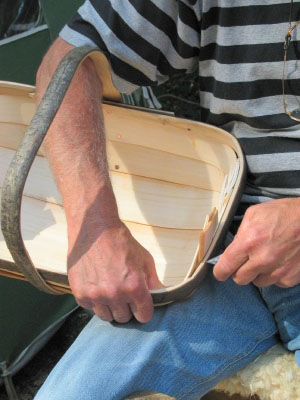
Great apprenticeship opportunity trug maker

Wanted apprentice trug maker, full details below. Apprenticeships in established traditional crafts companies are rare so this is a great opportunity for the right person.


Job Description – Apprentice Trug Maker


Cuckmere Trug Company, Berwick Court Farm, Alfriston Road, Berwick,   East Sussex, BN26 5QS.

Job Description:                   Apprentice Trug Maker

Department:                          Royal Sussex Workshop/South Down Workshop

The Company’s Apprenticeship Scheme lasts for three years and is aimed at the apprentice becoming a skilled Craftsman Trug Maker after that period of training.  Applicants should, therefore, be prepared to undertake the scheme enthusiastically for the full term of the apprenticeship.


1.              PURPOSE AND DUTIES

A.    PURPOSE


a)          To manufacture Sussex Trug Baskets and other craft related products.

b)         To work conscientiously as a member of a team based operation within own work area and spanning all Workshops.

c)          To ensure that the Company’s production and despatch targets are achieved for designated Workshop.

d)         To learn how all of the Company’s products are made.


B.    DUTIES


a)     To produce good quality products that the Company can offer for sale to its customers with pride.

b)   To work with the Master Trug Maker in charge of own designated Workshop and other staff therein to meet the Company’s Production Targets.

c)      To ensure that all customers’ orders are despatched on time.

d)     To accept individual responsibility for advising Master Trug Maker of immediate and future raw material requirements, when identified.

e)      To accept individual responsibility for the implementation and observance of Health & Safety and other statutory regulations.

f)      To ensure a clean and safe working environment for self and colleagues.

g)     To accept individual responsibility for advising the Master Trug Maker of any dangerous or suspect machinery or procedures and for advising him/her of any accident, dangerous occurrence, condition or procedure.

h)     To carry out own work in a cheerful, friendly and helpful manner as part of a closely knit Team.

i)      To take pride in producing a first class, craftsman made crafts products.

j)      To attend shows for the purpose of demonstrating and selling the company’s products.  Shows may be in Great Britain or elsewhere in Europe as required.  This will involve weekend work away from home during the show season.


2.              RESPONSIBILITIES

To learn and master the various techniques involved in making the Royal Sussex Traditional Trug and the South Down Contemporary Trug.  This will involve mostly hand tool work but, after the age of 18 will also include some use of wood working machinery, such as rip saw, band saws and sanders. It is anticipated that the successful applicant will also be involved in creating crafts other than Trugs.


 3.           RELATIONSHIPS  

Accountable directly to the Master Trug Maker responsible for your designated Workshop but working with, and learning from the other Trug Makers in the two workshops.


      4.          PHYSICAL CONDITIONS

The position involves purely manual work.   The jobholder is expected to learn all aspects of the Company’s production within the Royal Sussex and South Down Trug Workshops and become proficient in their implementation.   This position includes varied work as directed by the Proprietor and some heavy lifting on occasions.


5.          SOCIAL CONDITIONS

                              The job holder will enjoy a close working relationship with the Proprietor, Master Trug Maker and other members of staff and daily contact with members of the public and trade customers.

6.          ECONOMIC CONDITIONS

Hours:                     0830 – 1300 and 1400 – 1700 on days designated within Contract of Employment.
                              Overtime is compulsory if required.    Staff are expected to finish the work that has been set for them, and assist their colleages to finish, before quitting for the day.

Wages:                    £2.75 per hour at age 17 – 19 and £4.98 per hour at age 20 and over, paid one week in arrears. 

Annual Leave:           Statutory Annual Holidays, plus public holidays as recognised by the Company, or time off in lieu.   Holidays will be taken in arrears.   One annual holiday week to be taken at Christmas/New Year break.

7.             PERSONAL CONDITIONS


a)    The preferred age range is 17 - 21 years, depending upon the candidate.

b)   Must be fit and willing to work hard, doing long hours when needed to get the job        finished on time for our customers.
                     
                             c)  Employee must be able to commit himself/herself to the Company and to making good quality products within a closely-knit Team environment.

d) MUST have reliable transport or be able to travel in on time on public transport.  Times can be varied to allow for public transport schedules.

8.             FUTURE EMPOLYMENT

Following the successful completion of the apprenticeship period the company would anticipate engaging the applicant as a Craftsman Trug Maker.  Following graduation it is expected that the new Craftsman would also be willing to attend courses in other craft products in order to bring enrichment to the company for the future.


Video of trugmaking 

Tuesday, 29 January 2013

grant opportunity for craftspeople?

Could this be an opportunity for craftspeople? There is £1.25 million government money to  be invested in grants of up to £25,000 for new designs with low environmental impact. If folk use good quality stuff they throw away less.

MADE BY BRITAIN


£25,000 Competition from the TSB


Win up to £25k of co-funding to design new products that make better use of resources


The Technology Strategy Board, the UK’s Innovation Agency, will shortly be opening the second round of the “New designs for a circular economy” competition. This competition is intended to help companies work with new partners to radically rethink the design of products, components or systems and generate value by retaining or regenerating materials and components over several cycles of use.
Manufacturing companies are well acquainted with high or volatile prices and the risk of materials shortages that are a consequence of increasing global competition for raw materials. “Circular economy” approaches can help manufacturers protect themselves against these pressures by developing long-term value and a deeper, more service-oriented relationship with the customer.
The second round of the competition opens on 11 February 2013, with a mandatory registration on noon 20 March 2013. The deadline for all applications is noon 27 March 2013.
Interested?
·         Read more about the thinking behind the programme here
·         Download the competition brief directly here
·         Contact John Whittall at the Technology Strategy Board to find out more, john.whittall@tsb.gov.uk

Tuesday, 22 January 2013

Chair caning

By Brian Crossley, HCA Secretary, a second generation professional chair caner with 50 years experience.

Chair used by John Ruskin when a child

Chair Caning has been practiced as a craft in the UK since the late 17th century when it was - and still is – associated with the craft of basketmaking.  Today the craft concentrates on restoration with virtually no new caned furniture using the traditional techniques.

The material used is an outer layer (similar to bark) of the branches of a species of the Rattan Palm tree growing in the rain forests of the Far East, principally Indonesia, which unusually climbs in the forests looking for light.  Each branch can grow up to 200 metres long and is of constant diameter.

The original technique of chair caning uses a hand prepared single strand of cane woven through holes around the panel to be caned, in six distinct stages to create a pattern ‘the six way pattern’ which is used in almost all caned panels.  This pattern is known to have been in use from as early as around 200BC.  Caned panels are used mainly on chair seats (also their arms and backs) and to a much lesser extent on other types of furniture.

Part of a chair back

Seven different widths of cane are available, the exact width used being dependant on the spacing of holes in the panel to gave the right balance of ‘cane to fresh air’ – not too flimsy and not too crude.

Caned furniture responded to changes in fashion and in the first period, 1670 to 1720, chairs had caned seats and very high caned backs.  Prior to this, seats were in leather, wood or upholstered.  The attraction of caned furniture at the time was that it was light in weight, easily cleaned and did not harbour vermin - unlike upholstery. 

Chair circa 1710

The next period of use was the Regency period from around 1790 to 1820 when cushions were typically used on the seat.

Regency period armchairs

Until this time, most furniture in the UK was made in London, in and around the area known as St. Paul’s Church Yard.  However with improvements in transport and the ready availability of wood and Windsor chair making skills, manufacture of virtually all caned furniture in the UK moved to the High Wycombe area.  Caned furniture made here progressed in the period 1830 up to the First World War from being a cottage industry to major factory manufacture with many hundreds of thousands of items being made - but caning remained as a hand craft.

Sofa with ‘Spiders Web’ back panels
 
There was a major development in Europe around 1850 when Michael Thonet (born in Germany but working in Austria), developed the ability to bend solid wood and in came a major source of cheap durable bentwood furniture, most of which had caned seats and other caned panels.  Each of his five factories had around 300 chair caners and the business made many millions of caned chairs, exported around the world in a flat pack format.

Bentwood chairs circa 1890

After the Second World War, the only furniture in Europe using cane was by Scandinavian designers who also utilised the fashion for teak frames.  However a technique which did not take off in the UK or Europe was the use of machine woven cane, developed in the USA in the mid 19th century when two major developments took place.  First was the ability to cut the outer layer off a branch by machine whilst preserving intact the central core and second, the machine weaving of a roll of cane up to 36 inches wide (90 cm).  This material is mechanically attached to the panel frame in a groove and locked into place with a spline pressed into the groove.  Virtually all new caned furniture now uses this technique.

Chair with machine woven cane panels

Today, the craft of chair caning by hand is used to restore furniture of all periods from the very first caned chairs made in Europe in the late 17th century to the modern machine woven cane seats. However, the traditional techniques are now being used on other applications.

Design using traditional technique and woven pattern