Nice vid of Balvenie Masters of Craft.
Thursday, 7 July 2011

Wednesday, 6 July 2011
Marcel Duchamp and a prediction about art and craft
We are approaching a very important centenary in the art world, the creation of Marcel Duchamp's "fountain", arguably the most important work of art of the 20th century. Was he taking the piss? and why should craftspeople have any interest in it?

The point of fountain was that Duschamp was arguing that aesthetics and skill were not what made art, it was the artists idea that mattered.
Under the guise of an assumed name R Mutt, Duchamp submitted a porcelain urinal as an entry for an open exhibition in New York in 1917. With this work Duchamp metaphorically urinated on the bourgeois art institution and its adoration of what he referred to disparagingly as ‘retinal art’. "Fountain" was "misplaced" for the duration of the exhibition and lost soon afterward yet years later it achieved seminal status. It was not the worlds first ready-made, Duschamp showed "bicycle wheel" in 1913 but it is fountain that became iconic.
So what is the relevance today? Well trace Duschamps ideas forward 100 years and we see a century of art where skill and aesthetics were not seen as important and where ready-mades and installation art were where it was at. That century is coming to an end and personally I feel that the current art world is as self obsessed and out of touch as the one which Duschamp so successfully took the piss out of 100 years ago. Frankly there is only so much navel gazing and exposing to public view the least pleasant aspects of your past that the public want to see and after a while does it have any relevance or serious message?
So who will be the new Duschamp? Who will challenge the current ideas of where artistic merit lies? And where will that merit be found? Personally I fancy we will see a return to or perhaps some new form of appreciation of aesthetics and skill. I think we will again appreciate an artist who can create something of great beauty more than one who presents ready-mades or installations with some art speak justification. Why will this happen? Well in part what we have always admired and valued throughout history has been rarity and today there are not many folk that can grind pigments, mix oils and paint a decent picture, nor carve a stone for a cathedral window, nor make a basket, nor forge a gate hinge, yet conceptual art is taught to tens of thousands of university graduates every year.
Satchi et al have huge vested interest in maintaining the artistic status quo and will rubbish any suggestion that these things have as much merit as Emin's latest but I genuinely feel they have more to say of importance to today's world than most conceptual art. They comment on how we make the stuff of everyday life, on working conditions and waste and sustainability. It will be a few years coming but my prediction is that we are approaching the time when someone who makes humble functional craftwork will be valued as much as someone who makes art installations. And the funny thing is that I reckon if Duschamp was around today he would be rebelling against today's art institution as much as he did in 1917.

Tuesday, 5 July 2011
ministers support for crafts
Yesterday I was in Westminster again for a meeting with John Hayes the skills minister.
It is difficult to put into words how positive things are for traditional crafts at the moment. After years of being the poor relation to the innovative artistic end of the craft spectrum it seems things are really changing.
The ministers officials are working on a plan with various key points to help and support traditional crafts. First and most important there will be a mapping project which will identify how many traditional craftspeople are out there, which crafts are healthy, which in danger of dying out and which offer good opportunities for growth. This will also look at training provision and entry routes to the crafts, we have a lot of anecdotal evidence that suggests that once established traditional crafts businesses are doing quite nicely with strong consumer demand but it is difficult to get established and get funding for training.
This will be a second strand of the ministers work looking at apprenticeships and the best and most appropriate ways of addressing the issues the research highlights.
A third and equally important strand will be the development of a high profile craft award to truly recognise the contribution of dedicated craftspeople make to our cultural heritage.
This will all take a long time to filter down to show benefits to individual craftspeople in their workshops but it will happen and it will make a difference. Another thing that will make a difference in the shorter term is there seem to be a plethora of TV shows in the pipeline at the moment. Barely a week goes by without the Heritage Crafts Association being contacted for information about potential craftspeople to feature in new series. The pitches vary quite a lot but one we heard about today sounds a real winner and we are hoping it will make it through the commissioning process. Can't share details at this stage but there is no doubt in 6-12 months time there will be a whole lot of craft on your TV.
Tuesday, 28 June 2011
crafts at Glastonbury 2011
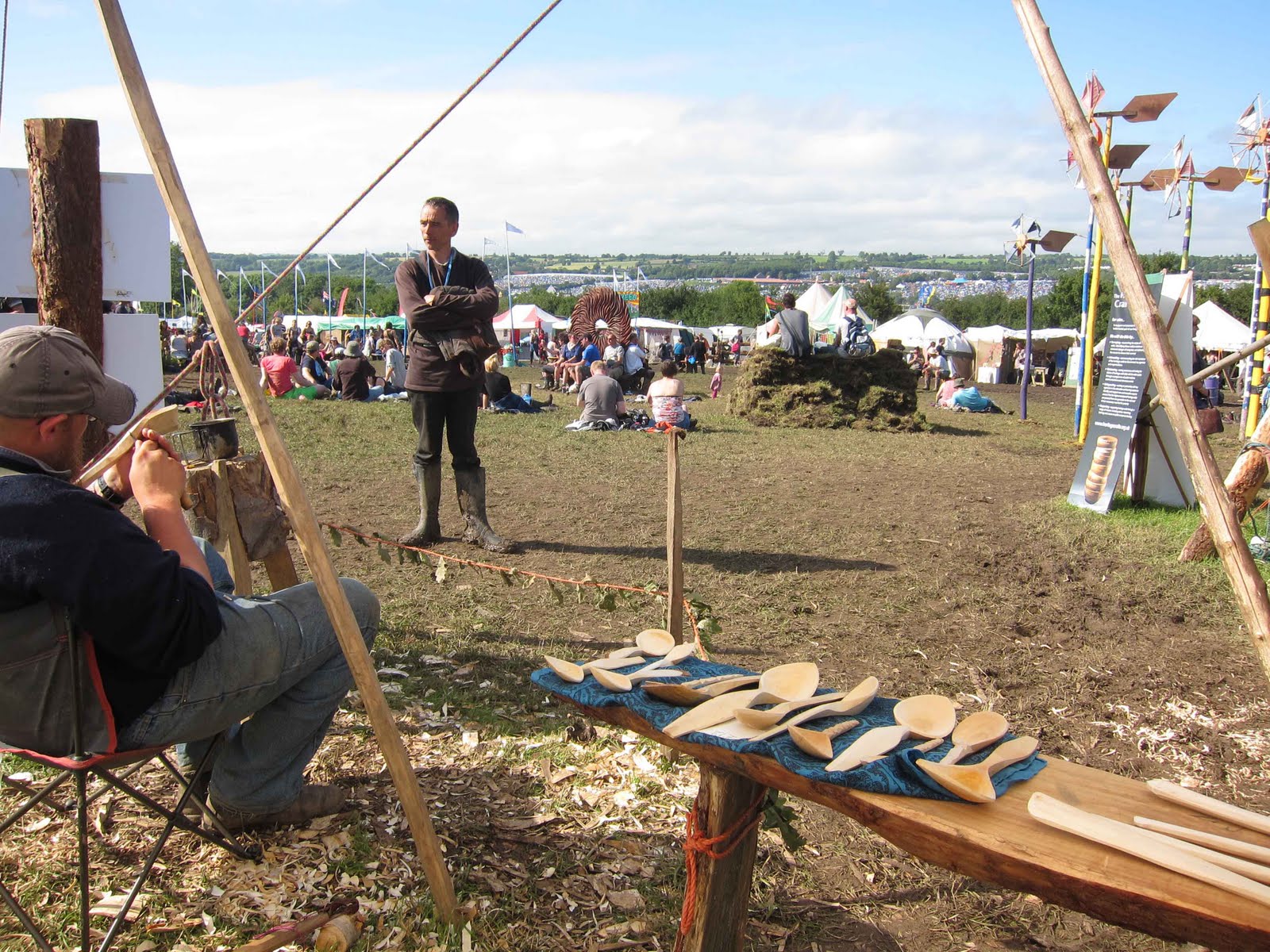
Just back from Glastonbury which for foreign readers is the biggest music and arts festival in the world and a rather special event. We had a Heritage Crafts Association area which was the nicest spot on the nicest field on the whole site, forget the horrendous mud images of the TV and papers we were camping in style.
 This was the view from my lathe
 It was great fun this year to have friends along from the HCA to share the campfire with in the evenings, next door Sophie Hussain was demonstrating stained glass and running workshops where lucky folk got the chance to make their own small glass panel.
 And here are a few of Sophie's panels in the evening sun


 The media love pictures of mud and when you get 250,000 people in a field and a shower of rain all those feet very rapidly do bring the mud up. Here are the first visitors arriving.
 And this phot taken from the same spot 48 hours later looking down the hill, these folk are queing for the loos.
 Our field is high on the hill though overlooking the site and gets less footfall than most so even after rain it was not too bad. This was as bad as it got, this is Barn who came and helped me and demonstrated spoon carving.

I have lots of happy memories of time spent sat around the campfire with Guy, Sophie and all our friends and helpers, a week away from the computer in a field sharing song, dance and a good whisky is pretty good therapy.
 Last two random pics, there is so much to see and do there and I tend to experience it without the camera.
 A turf sofa.


Guy Mallinson another of the tutors from the "Mastercrafts" TV program brought his gorgeous parachute shelter along and was running spatula making workshops.

One of the great things about working at Glastonbury is that you get to go a few days before the public arrive and enjoy the build up before the chaos starts. It is known for music and there must be 100 stages for live music ranging from the huge main stages with 20,000 in the audience to a piano in a tent, or even in a field.

Many go for the big names from U2 to Beyonce but I love wandering and dropping in on little gigs on small stages. Whilst performances may not have the polished professionalism you get real passion and fun. Top score this year was Mumford and Sons playing a tiny campfire gig for about 250 folk in Strummerville a place where the spirit of Joe Strummer lives on.
We were there for 8 days and saw the dawn on 5, this is sunrise over the HCA area, Glastonbury is quite a nocturnal place.


I have lots of happy memories of time spent sat around the campfire with Guy, Sophie and all our friends and helpers, a week away from the computer in a field sharing song, dance and a good whisky is pretty good therapy.


Wednesday, 15 June 2011
pottery in Stoke
I am no expert on pottery in Stoke but was just horrified to learn that Wedgwood has moved production to Jakata, Indonesia.
Here is a short youtube of the Wedgwood factory "Made in England"
and a longer one of a guy demonstrating throwing.
Now listen to BBC Radio Stoke doing a 3 minute feature from the Wedgwood factory in Jakata, "a little bit of Stoke in Indonesia"
Surely people buy Wedgwood as a heritage brand and once you move it to Indonesia don't you loose most of what made it special?
Emma Bridgewater thinks so this is her Stoke factory.
and a last bit of good news HCA president HRH The Prince of Wales has stepped in to save Middleport Pottery one of the last potteries working in stoke. More on the story here.
Friday, 3 June 2011
Balvenie Masters of Craft awards on TV
Nice clip of the Balvenie Masters of Craft Awards on NTD TV this clip focuses on Stewart Hearn of London Glassworks who won the ceramics and glass category. It was a fun evening and I was delighted to be presenting awards to such talented folk.
Balvenie Masters of Craft awards
Last night a select group of craftsfolk from around the UK left their workshops and headed to a very posh hotel in London's Mayfair (yes the one with the most expensive houses on the monopoly board and in real life too) We were at the Connaught to celebrate the winners of the Balvenie Masters of Craft Awards, I had the honour of being one of the judges and presenting some of the awards. We had a great judging team but craftsfolk are most likely to know Kevin McCloud off the TV and Nick Hand wonderful crafts photographer.
Well it was a wonderful evening, hosted by warm friendly folk from the Balvenie. The stars of the show though were the craftspeople so lets announce the winners.
Wood winner and overall Balvenie Master of Craft 2011: Christoph Gotting, violin maker
Christoph Gotting spent 20 years renovating the best 17th century instruments made by the like of Stadivari followed by another 20 making new instruments of the best possible quality. Apparently the ground and varnish are play a major part in the difference between a good violin and a great one. Christoph has undertaken 800 meticulously recorded varnish tests to produce instruments that are the probably the closest currently available alternative to an original Strad.

Emily Ruth Davey, shoemaker
Ruth operates a shoemaking business from her workshop on the mid-Wales coast. She says her customers range from dukes to dustbin men, from young to old, yoga teachers, artists, poets, doctors and even the odd film star. Testament to her success is her current search for an apprentice

Glass and ceramics winner: Stuart Hearn, glass blower
Stewart has been blowing glass for 28 years and runs London Glassworks. While his pieces celebrate traditional craft, they also have a strong contemporary aesthetic. Stuart is passionate about passing on skills and provides regular training and workshops

Textiles winner: Iain Finlay McLeod, weaver
Iain is the fourth-generation weaver in his family. On the Isle of Lewis, he and his team of five weavers create high-quality cloth on traditional looms over 70 years old. They sell their cloth to some of the best tailors and fashion houses in Tokyo, London and Beverley Hills

Stone winner: Jacqueline Cullen, jeweller
Jacqueline is a jeweller working with Whitby jet. Specialising in Victorian mourning jewellery, Jacqueline has developed innovative processes and formats that celebrate rather than disguise the inherent flaws of Whitby jet, allowing the natural beauty of the material to speak for itself

Leather winner: Deborah Carre, shoemaker
Deborah is a hand-sewn shoemaker. She is currently building a business that focuses on making bespoke men’s shoes by hand and has a new workshop on the shop floor at Gieves & Hawkes, 1 Savile Row, London

Metal winner: Wayne Victor Meeten, precious metalworker
Wayne is a silversmith, goldsmith and precious metalworker, who aims to push the boundaries of traditional smithing by using 21st century technology. His designs are contemporary with wonderful form, line, texture and structure

After the food and the awards we enjoyed some very fine whisky, my favourite of the evening being the 21 yr old Balvenie portwood, rather out of my budget but delightful to experience. It was quite moving to see how touched Christoph particularly was to receive his award and I hope this helps shine the light on these folks dedication and skills and raises the profile of craftsmanship generally.
Subscribe to:
Posts (Atom)



 Posts

